

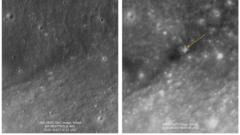
South Korea’s Korean AeroSpace Administration released imagery documenting the aftermath of a SpaceX Falcon 9 rocket upper stage collision with the lunar surface. The impact occurred at approximately 06:35 GMT on Wednesday, according to the agency. The lunar orbiter Danubri captured comparative images showing both the impact area and pre-collision photographs of the same lunar region.
The colliding object was the empty upper stage of a Falcon 9 rocket, approximately the size of a five-story building and weighing roughly 4,000 kilograms on Earth. Scientists calculated the impact velocity at approximately 5,400 miles per hour. SpaceX confirmed the impact was unintentional. The upper stage had been in orbit since January when it launched from Florida carrying two lunar landers, and spent 18 months in a gradually degrading orbit before striking the Moon.
The collision produced only a brief, faint flash that would have been imperceptible to amateur astronomers even with high-powered telescopes, though larger observatories including Seoul’s space agency are analyzing the impact data. The impact posed no threat to Earth. However, the incident prompted discussion about space debris concerns. Matt Bothwell, an astronomer at the University of Cambridge, expressed concern about accumulating orbital congestion, noting that increased launch frequency could eventually make Earth orbit navigation significantly more difficult within several decades.
The Falcon 9’s booster section involved in the mission is scheduled to conduct its 18th flight on 10 August, with plans to deploy 29 Starlink satellites to low-Earth orbit, according to SpaceX.
Article Attribution | Read More at Article Source
Article summary produced by Claude AI