

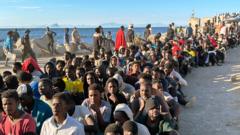
Spain has implemented temporary border controls affecting all air and sea travelers arriving from Italy, effective at midnight on the day of the announcement and scheduled to remain in place until early September. The measure follows Italy’s decision, announced approximately one week prior, to suspend the Schengen open-border agreement for third-country nationals entering from Spain. Italy’s action was triggered by an influx of roughly 78,000 migrants from Morocco who attempted to enter the Spanish exclave of Ceuta.
The escalating dispute reflects differing positions between the two European Union member states. Spain’s government asserts that Italy’s border suspension lacks factual justification, describing the reasoning as based on “spurious arguments” given that migrants reaching Ceuta have no avenue to enter the broader Schengen zone. Italy maintains that its temporary controls are necessary security measures to prevent onward travel of migrants to Italian territory and to address unspecified security and terrorist risks. Italian officials have stated that checks are conducted to ensure traveler comfort, with European Union citizens exempt from enhanced screening, though recent reporting indicates substantial queues at Spanish airport terminals.
The political confrontation pits Spain’s socialist Prime Minister against Italy’s conservative leader, who has historically advocated for stricter European migration policies. Italy’s position has received backing from Finland and Denmark, while the Czech Republic called for more severe consequences regarding Spain’s EU status. The Schengen accord suspensions, while causing disruption, are not without precedent in European practice, as similar measures have been maintained elsewhere.
Regarding the underlying crisis, most migrants who reached Ceuta were returned within days, though approximately 1,400 minors remain in the enclave. Roughly 100 migrants are believed to have perished during crossing attempts. The European Union’s Migration Commissioner has suggested criminal networks disseminated misleading information to encourage the crossings. The migration surge followed a Spanish court ruling that migrants cannot be summarily returned to Morocco, a decision Morocco has blamed for destabilizing deterrent systems. Online activity suggests potential for additional crossing attempts in mid-August, though Spain’s government indicated it does not anticipate a repeat of previous-week events.
Article Attribution | Read More at Article Source
Article summary produced by Claude AI