

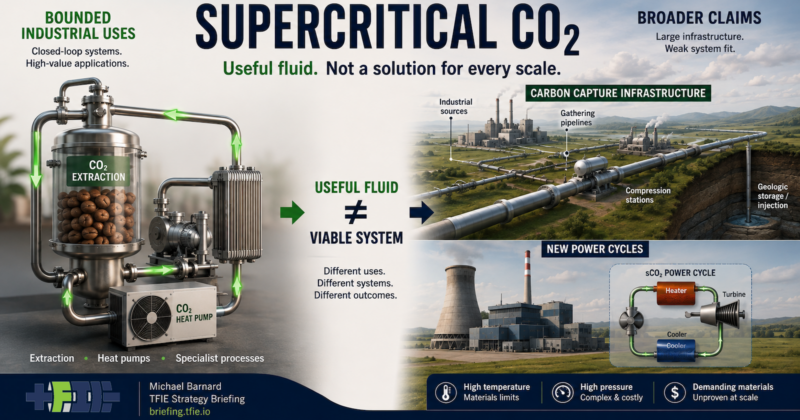
Supercritical carbon dioxide, a state of the gas above 31 degrees Celsius and 73.8 bar of pressure, has established uses in specialized industrial applications including caffeine extraction, plant compound separation, and certain heating and cooling systems. These applications operate within controlled, closed systems with manageable inventories of the fluid.
Scaling carbon dioxide handling to support large-scale carbon capture from distributed industrial sources presents fundamentally different technical and economic challenges. Compressing CO₂ from atmospheric pressure requires approximately 90 kilowatt-hours per tonne, and transporting it via pipeline requires maintaining specific pressure, temperature, and composition parameters while managing water and impurities. The United States operates approximately 2,600 kilometers of CO₂ pipelines, primarily developed for enhanced oil recovery applications connecting concentrated sources to oil fields. Establishing a network to serve distributed industrial facilities could require roughly 1.3 million kilometers of pipeline infrastructure, producing estimated capital costs around 12 trillion dollars based on unit construction costs.
Expanding pipeline networks through densely populated areas introduces safety considerations not present in existing specialized networks. A 2020 CO₂ pipeline rupture near Satartia, Mississippi resulted in dozens of hospitalizations and over 200 evacuations after a landslide damaged the line. Dense CO₂ releases can create dangerous ground-level concentrations before dispersal, requiring new design standards, regulatory frameworks, and emergency response protocols across expanded infrastructure.
Supercritical CO₂ is also promoted as a working fluid for power generation cycles, keeping the fluid in closed systems and avoiding pipeline complications. However, research dating to 1948 has not overcome persistent engineering barriers including corrosion, micropitting, and demanding material requirements. The technology must compete within a narrowing market as wind and solar capacity expands and heat pumps replace combustion-based thermal systems.
While supercritical CO₂ functions effectively in closed-loop industrial applications, broader implementation requires addressing compression energy requirements, extensive infrastructure development, safety management, materials science challenges, and market competition—factors that distinguish successful technologies from those with interesting physical properties alone.
Article Attribution | Read More at Article Source
Article summary produced by Claude AI