

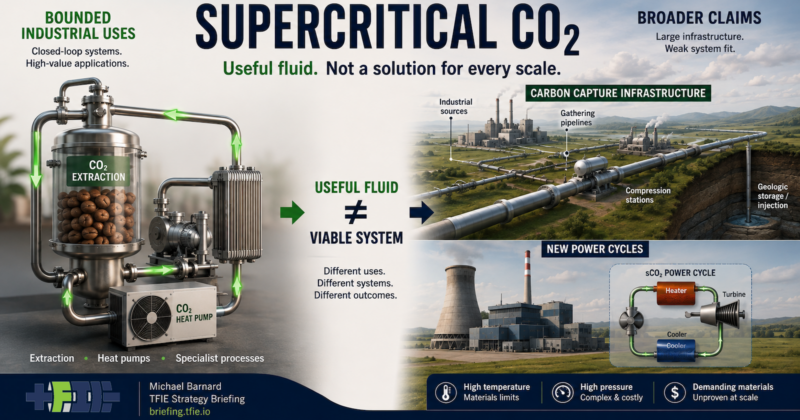
Supercritical carbon dioxide, a state achieved above roughly 31° Celsius and 73.8 bar, possesses genuine utility in several established industrial applications. These include caffeine extraction from coffee, compound separation from plant materials, replacement for problematic chemicals in cleaning processes, and use as a working fluid in heat pumps and refrigeration systems. However, current applications operate as controlled, closed systems with comparatively small inventories of the fluid circulating within equipment designed for known operational parameters.
A substantial difference emerges when considering large-scale carbon capture and management systems that would move millions or billions of tonnes of CO₂ from distributed industrial sources through pipeline networks for underground storage. Compressing CO₂ to supercritical densities requires significant energy input, estimated at roughly 90 kilowatt-hours per tonne from room-temperature atmospheric pressure. Maintaining the fluid within necessary pressure, temperature, and composition ranges across extensive pipeline networks requires additional infrastructure including booster stations, conditioning equipment, and corrosion management systems.
The United States currently operates approximately 2,600 kilometers of CO₂ pipelines, primarily developed for enhanced oil recovery connecting concentrated sources to oil fields across sparsely populated areas. A distributed carbon-management network connecting multiple industrial facilities would face a dramatically different scale problem. Preliminary estimates suggest such a system could require approximately 1.3 million kilometers of pipeline—roughly 500 times the existing baseline—with associated capital costs around $12 trillion. Such expansion would extend through densely populated areas, increasing exposure to failure risks including the dangerous ground-level gas concentrations demonstrated in a 2020 pipeline rupture near Satartia, Mississippi, which hospitalized dozens and required evacuation of over 200 people.
Supercritical CO₂ is also promoted for use in thermal power cycles as a replacement for water and steam. This closed-loop application avoids pipeline infrastructure concerns but faces other challenges. The technology, first prototyped in 1948, has remained under development for decades while addressing persistent engineering problems including corrosion, micropitting, and demanding material requirements. The commercial market prospects are constrained by the cost of retrofitting existing coal or nuclear plants, mature competing alternatives in natural gas facilities, and the expanding role of wind, solar, and heat pump technologies in new electricity capacity.
The assessment of supercritical CO₂ extends beyond its physical properties to encompass complete systems integration including compression energy, infrastructure requirements, safety considerations, materials selection, operations, and competitive alternatives. While established industrial applications remain viable, broader scaling of the technology requires addressing these interconnected system-level factors.
Article Attribution | Read More at Article Source
Article summary produced by Claude AI