

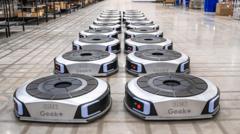
Geek+, a Chinese manufacturer of autonomous mobile robots, has established itself as a leading automation supplier in the United Kingdom’s logistics sector. The company’s floor robots navigate warehouses using QR code markers, lifting and transporting storage shelves to workers, thereby increasing picking speeds and warehouse storage capacity. Major British retailers including Tesco, Asda, and Next have adopted the technology, with partner company MotionTech deploying more than 2,000 robots across 10 UK warehouse sites.
The expansion reflects broader productivity challenges in the British economy. The Organisation for Economic Co-operation and Development noted in its 2026 report that the UK has lagged behind in robotics adoption relative to other mature economies, despite having significant manufacturing heritage. With one of Europe’s largest e-commerce and logistics sectors, many British warehouses remain in early automation stages, presenting growth opportunities for companies like Geek+.
According to industry representatives, UK businesses are seeking rapidly deployable automation solutions to address persistent labour shortages while maintaining high volumes and fast processing speeds on reduced physical footprints. However, the Trades Union Congress has called for worker involvement in automation decisions and employer investment in retraining, emphasizing that robotics should enhance productivity and job quality rather than simply reduce headcount.
China has prioritized robotics as a strategic sector under broader industrial policy, with major technology companies including XPeng and various robotics startups developing advanced systems. Analysts note China’s robotics sector benefits from overlapping industrial ecosystems with its electric vehicle industry, leveraging shared battery, sensor, and semiconductor technologies. However, recent US sanctions banning imports of advanced foreign-made robots may impact China’s global robotics expansion. For the UK, Chinese-made warehouse robots represent the current technology frontier, though humanoid robots remain in earlier developmental stages with unclear commercial applications in industrial settings.
Article Attribution | Read More at Article Source
Article summary produced by Claude AI