

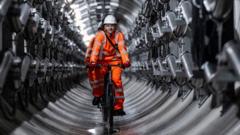
A California-based company called EarthGrid has demonstrated a plasma-powered tunnel-boring machine capable of melting through granite at extreme temperatures. The machine, which uses three plasma torches reaching 27,000 degrees Celsius, successfully bored through three meters of rock during a test conducted in January. The technology aims to make the process of placing critical infrastructure underground—including power cables, telecommunications lines, data centers, and pipelines—more efficient and economically viable than current methods.
Demand for undergrounding infrastructure has grown significantly in recent years, with engineering firms reporting increased client interest. The Russia-Ukraine war has highlighted vulnerabilities in above-ground facilities to drone attacks, prompting countries particularly near Russia to explore protective measures. Beyond cable and pipeline applications, the technology could support underground freight-distribution systems around airports and warehouses. EarthGrid’s leadership anticipates commercial deployment of the tunnel-boring machine as soon as next year, pending technical refinements to improve directional accuracy.
The broader trend toward burying infrastructure reflects both security and practical considerations. Data centers are increasingly relocating underground, exemplified by a recently completed facility installed 100 meters deep in Italy’s Dolomite Mountains, which leverages natural cooling and geological protection. Submarine internet cables, which span thousands of kilometers beneath oceans, have shown reduced fault rates as burial practices have become more common. Advanced technologies including laser-guidance systems and gyroscopes have improved tunneling accuracy in recent years.
However, significant obstacles remain. Tunneling typically costs several times more than above-ground infrastructure installation, limiting widespread adoption. Challenges include managing potentially hazardous gases trapped in rock and addressing flooding complications. In the United Kingdom, no major shift toward undergrounding has emerged outside specific high-density urban applications, where alternatives such as installing additional circuit capacity may prove more cost-effective than excavation projects.
Article Attribution | Read More at Article Source
Article summary produced by Claude AI