

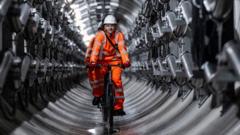
Emerging tunnel-boring innovations are expanding the feasibility of placing critical infrastructure underground, addressing growing demand driven by geopolitical concerns and technological advances. EarthGrid’s plasma torch-equipped boring machine recently demonstrated capability in California, melting through granite using superheated plasma to create tunnels more efficiently than conventional methods. The company aims for commercial deployment as early as next year for projects involving power cables, fiber optics, pipelines, and underground freight systems.
The shift toward undergrounding reflects lessons learned from recent conflicts, particularly Russia’s war with Ukraine, which demonstrated vulnerabilities of above-ground facilities to drone attacks. Engineering firms report increased client interest from countries bordering Russia seeking protected infrastructure. Underground locations also offer operational advantages: data centers installed in natural caverns, such as the facility in Italy’s Dolomite Mountains, benefit from naturally cool conditions that reduce cooling costs and energy consumption while providing protection against physical intrusion and electromagnetic interference.
Technological improvements have enhanced tunneling accuracy and speed. Laser-guidance systems and gyroscopes now allow machines to maintain precise positioning, while innovations in boring equipment increase excavation rates, though progress remains measured in millimetres per minute. Subsea internet cables, which span thousands of kilometers underwater, show improved reliability when buried up to three meters deep, with some fault-prone areas burying cables along their entire lengths.
Challenges to widespread undergrounding remain substantial. Tunneling costs several times more than above-ground alternatives, making it viable primarily for high-density urban areas or specialized security applications. Technical obstacles include managing potentially hazardous gases released during excavation and managing occasional flooding. In the UK, significant expansion of underground critical infrastructure has not yet materialized, though projects like the London Power Tunnels demonstrate feasibility in congested areas where space constraints justify the investment.
Article Attribution | Read More at Article Source
Article summary produced by Claude AI