

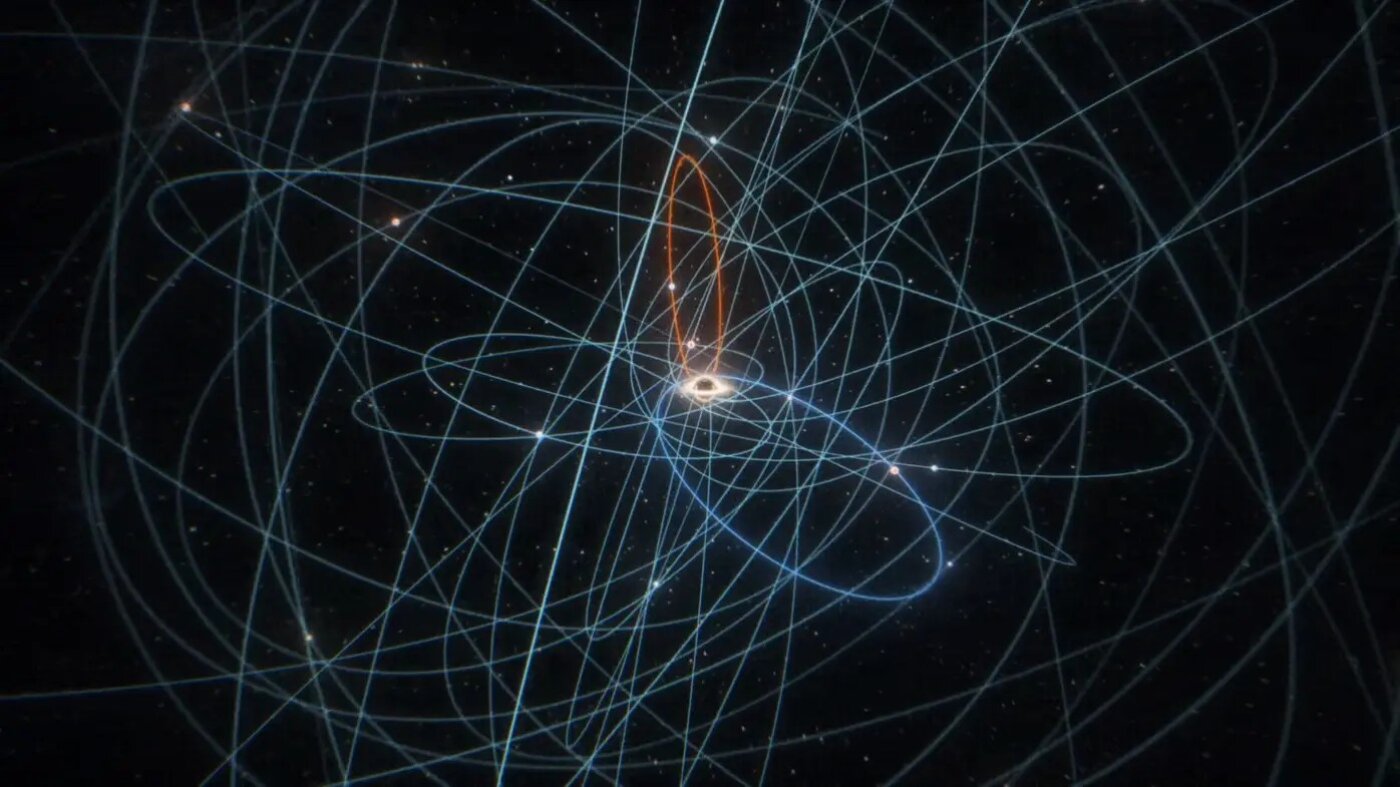
Researchers at the Max Planck Institute for Extraterrestrial Physics have published findings in the journal Nature describing a star designated S301 that orbits Sagittarius A*, the supermassive black hole at the center of the Milky Way galaxy. The star travels at velocities exceeding 15,000 miles per second—approximately 8% of the speed of light—making it the fastest star observed in the galaxy to date.
The discovery builds on decades of astronomical observation. Scientists determined in the fall of 2002 that the central object possessed a mass four million times that of the Sun, establishing its nature as a supermassive black hole. Using infrared telescopes at the Very Large Telescope site in Chile, researchers were able to observe the star by detecting light that penetrated cosmic dust and gas obscuring direct view of the galactic center. A Ph.D. student at the institute noticed faint movements in the data several years ago and subsequently tracked the star’s position over multiple years while reviewing historical observations.
Analysis of S301’s trajectory revealed a highly elongated elliptical orbit with an 8.7-year period. Calculations employing Newton’s laws of gravity, refined with corrections from Einstein’s general relativity, demonstrated that the star reaches maximum velocity during its closest approach to the black hole. The predictable nature of its orbit has been compared to the precision of railway systems, with the star’s position and velocity occurring at consistent intervals.
Scientists view S301 as a valuable tool for studying black hole properties. The star’s proximity and orbital characteristics allow researchers to measure how gravity distorts space and time in the vicinity of a supermassive black hole. The discovery may enable determination of how quickly Sagittarius A* rotates—a calculation previously performed only for actively growing black holes in other galaxies. Understanding the rotation rate of the local black hole could yield insights into the formation and evolution of the Milky Way galaxy itself, according to researchers commenting on the findings.
Article Attribution | Read More at Article Source
Article summary produced by Claude AI