

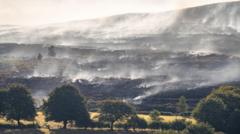
Torfaen, a county in Wales, experienced significant wildfire activity in July that resulted in notably elevated carbon emissions by global standards. A fire that broke out on Mynydd Garnclochdy, situated between Abersychan and Blaenavon, covered an area approximately equivalent to 300 football pitches. The blaze was characterized by fire service officials as among the largest and most challenging incidents in south Wales during recent years. The fire and related incidents in the region were substantial enough to trigger a major incident declaration, ultimately requiring military assistance to manage.
Data from Copernicus, the European Union’s earth observation programme, indicated that Torfaen’s wildfire emissions in July placed it among the world’s highest per square kilometre, trailing only Malanje in Angola, Ávila in Spain, and Annaba in Algeria. Save the Children expressed concern regarding potential health consequences from the emissions. The smoke from the fires spread considerable distances, with residents reporting detecting it approximately 30 miles away in Cardiff. Local councillor Janet Jones noted that smoke concentrations were particularly pronounced on 13 August, roughly three weeks after the fire’s initial ignition.
Air quality concerns prompted discussions about potential health impacts, particularly for vulnerable populations including elderly residents and those with respiratory conditions such as emphysema and chronic obstructive pulmonary disease. However, enquiries made by local officials to general practitioner practice nurses two weeks prior found no reported surge in respiratory complaints at that time, though officials acknowledged the situation could evolve. Torfaen council stated it maintained continuous air quality monitoring through a station in Croesyceiliog Cwmbran, which had detected elevated particulate concentrations during the wildfire period.
The council indicated it had not been previously aware of the Copernicus findings and questioned the methodology underlying the assessment. Officials emphasized that their monitoring station was designed to track general background air quality rather than conditions in immediate proximity to fire locations. The Copernicus Atmosphere Monitoring Service, part of the European Union’s Space programme, characterized the emissions recorded in Torfaen as “extremely unusual” and noted its role in providing global information on air pollution and health impacts.
Article Attribution | Read More at Article Source
Article summary produced by Claude AI