

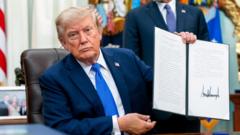
President Trump announced two executive orders on Thursday targeting birthright citizenship policies. The first order modifies eligibility requirements by denying automatic citizenship to children born in the United States when both parents are non-citizens and at least one parent falls into specified categories. These categories include membership in a foreign terrorist organization, employment by a foreign government, fraudulent citizenship attempts, or residence in US territories where citizenship is not conferred by federal statute.
The second executive order addresses birth tourism, defined as the practice of foreign nationals traveling to the United States specifically to give birth and secure citizenship for their children. Trump and his administration officials have emphasized concerns about this practice, claiming it represents an attempt by foreign actors to circumvent immigration rules. During the announcement, White House officials estimated the scope of birth tourism at considerable levels, though independent research organizations provide notably different figures.
The Migration Policy Institute, a nonpartisan research organization, reported that census-based estimates suggest approximately 22,000 to 26,000 births annually result from birth tourism in the United States. Government data showed approximately 9,600 births to mothers with foreign addresses during 2024. Administration officials, including homeland security advisor Stephen Miller, argued that birth tourism allows foreign nationals to gain access to citizenship benefits and protections for their children while leaving the country.
These orders represent a renewed effort following an earlier attempt that faced significant legal obstacles. Earlier in his administration, Trump signed an executive order seeking to end birthright citizenship as guaranteed by the 14th Amendment. The legal challenge to that order reached the Supreme Court, which ruled in June that the policy could not stand, determining that birthright citizenship remains protected constitutional law.
Legal experts have raised constitutional concerns about aspects of the new orders. Gabriel Chin, a law professor at the University of California Davis, stated that while the president possesses some authority to restrict entry for birth tourism purposes, once a child is born in the United States, the president lacks power to determine that child’s citizenship status. Chin characterized birth tourism as a relatively minor phenomenon relative to overall US birth numbers.
Article Attribution | Read More at Article Source
Article summary produced by Claude AI