

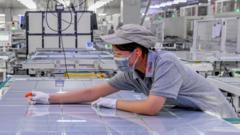
US President Donald Trump signed an executive order on Thursday establishing tariffs and price controls on imported polysilicon, a material essential to semiconductor and solar panel manufacturing. The measure imposes a 15% tariff on polysilicon imports and establishes minimum import prices for the product and related items, with implementation scheduled for December. The administration also plans to offer incentives designed to stimulate domestic production of the material.
According to Trump’s order, the policy responds to a national security investigation examining overseas polysilicon production. Trump cited statistics showing the United States’ share of global polysilicon production has declined from 50% in 2005 to less than 2% in 2024, while noting that polysilicon plays a critical role in military equipment and electronics. The order reflects Trump’s long-standing advocacy for tariffs as a tool to protect American manufacturing and employment. Commerce Secretary Howard Lutnick provided recommendations that informed the tariff level and price-setting mechanisms included in the order.
China currently controls a near-monopoly on polysilicon production globally. The Chinese embassy in Washington responded to the measure by stating it “seriously disrupts” bilateral trade and accused the United States of abusing governmental authority to target Chinese businesses. Beijing indicated it would take action to defend its companies and characterized the protectionist approach as counterproductive to US competitiveness.
Industry analysts tracking the development noted the tariff represents an escalation in Washington’s broader strategy to restrict China’s participation in critical technology supply chains. The measure aligns with previous US restrictions on imports of drones, humanoid robots, and other technology products from China. In response to recent US actions, China announced countermeasures this week, including tightened export controls on drones and initiation of a national security review into imported printers and copiers. The polysilicon tariff follows a period of relative stability in US-China trade tensions, with the countries’ tit-for-tat tariff exchange having remained on hold since May 2025.
Article Attribution | Read More at Article Source
Article summary produced by Claude AI