

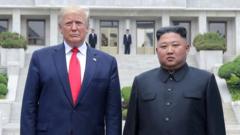
South Korea’s annual Ulchi Freedom Shield military exercises with the United States came to an abrupt halt on Friday, with only half of the scheduled programme completed. The decision followed an announcement by US President Donald Trump that he had directed the Pentagon to substantially reduce the drill, which involved 18,000 South Korean troops and 11 other American allied nations. Trump characterized the exercise as inappropriate, hostile toward North Korea, and economically burdensome to the United States.
South Korean Foreign Minister Cho Hyun attempted to frame the cancellation as a mutually agreed decision, but acknowledged that officials had not been informed in advance of Trump’s intent to scale down the exercise. The abrupt move has raised concerns among regional partners including Taiwan and Japan, which have historically depended on US security commitments in the region. Trump has indicated his expectation to meet with North Korean leader Kim Jong Un later this year and has criticized Seoul for declining to participate in actions against Iran.
South Korea has traditionally viewed the annual joint exercises as central to its alliance with the United States and as a demonstration of American commitment to its defense against North Korea. While Seoul has previously been willing to reduce or suspend these exercises to encourage North Korean participation in peace negotiations, experts note that Trump’s unilateral and sudden decision to withdraw troops has undermined South Korean confidence in US reliability as an ally. Concerns exist regarding potential further reductions of the 27,000 US troops stationed in South Korea or a shift away from longstanding denuclearization policies, potentially without consultation.
The Trump administration’s evolving approach to linking security and trade matters has created additional complications. In addition to military concerns, the administration has expressed dissatisfaction with South Korea’s defense spending contribution, its pace of pledged investments, and its treatment of US companies. These overlapping tensions have prompted some analysts to recommend that South Korea develop greater security independence, including consideration of nuclear weapons development, though the government has historically maintained that such acquisition would be unnecessary and potentially damaging to its alliance network.
Meanwhile, North Korea responded to the reduced exercises with statements indicating disinterest while reasserting its nuclear capabilities. Kim Jong Un’s sister, Kim Yo Jong, stated unfamiliarity with reports of recent contact between Kim and Trump, and reiterated that North Korea would not relinquish its nuclear weapons.
Article Attribution | Read More at Article Source
Article summary produced by Claude AI