

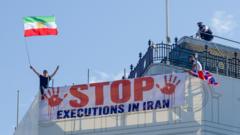
The United Nations human rights chief has raised concerns about an escalating pattern of capital punishment in Iran, characterizing executions as a mechanism to generate fear and suppress political opposition. Volker Türk reported that a minimum of 56 individuals have been put to death on charges related to national security since mid-March, with 27 of those cases connected to demonstrations that occurred in January. The official also warned that more than 100 additional individuals face potential execution on comparable charges, while the rate of death sentences for drug-related offences continues at levels described as concerning.
Iran ranks second globally in execution frequency, following only China, according to international assessments. The previous year saw at least 2,159 executions carried out, marking the highest recorded total since 1981 according to Amnesty International’s documentation. Among those figures, 45 individuals were executed on charges of suspected dissent and national security-related offences.
Human rights organizations have cautioned that Iranian authorities may increasingly resort to capital punishment against perceived adversaries in the wake of January’s civil unrest, during which thousands of demonstrators were killed and tens of thousands detained. Türk’s statement urged the Iranian government to cease all executions and pursue abolition of the death penalty altogether, characterizing such punishment as incompatible with contemporary standards. The UN official also highlighted persistent deficiencies in legal protections, including insufficient fair trial guarantees and allegations that confessions have been extracted through torture or other forms of abuse. Several cases have involved rapid sentencing following arrest, with one instance involving 12 defendants receiving capital sentences after a single three-hour closed hearing.
Recent documented cases include the execution of two individuals convicted of espionage for Israel, identified as Omid Behzad and Pouria Safvat, according to the judiciary’s news agency. A 19-year-old, Arvin Kheirkhahan, was executed following conviction on security-related charges stemming from alleged participation in the January unrest. Two additional defendants arrested during those demonstrations were executed publicly in Isfahan, and two more were put to death in July, all connected to charges arising from the deaths of four law enforcement officers in January. The Iranian government has not provided immediate response to the UN’s concerns but has previously justified capital punishment as reserved for only the most serious offences.
Article Attribution | Read More at Article Source
Article summary produced by Claude AI