

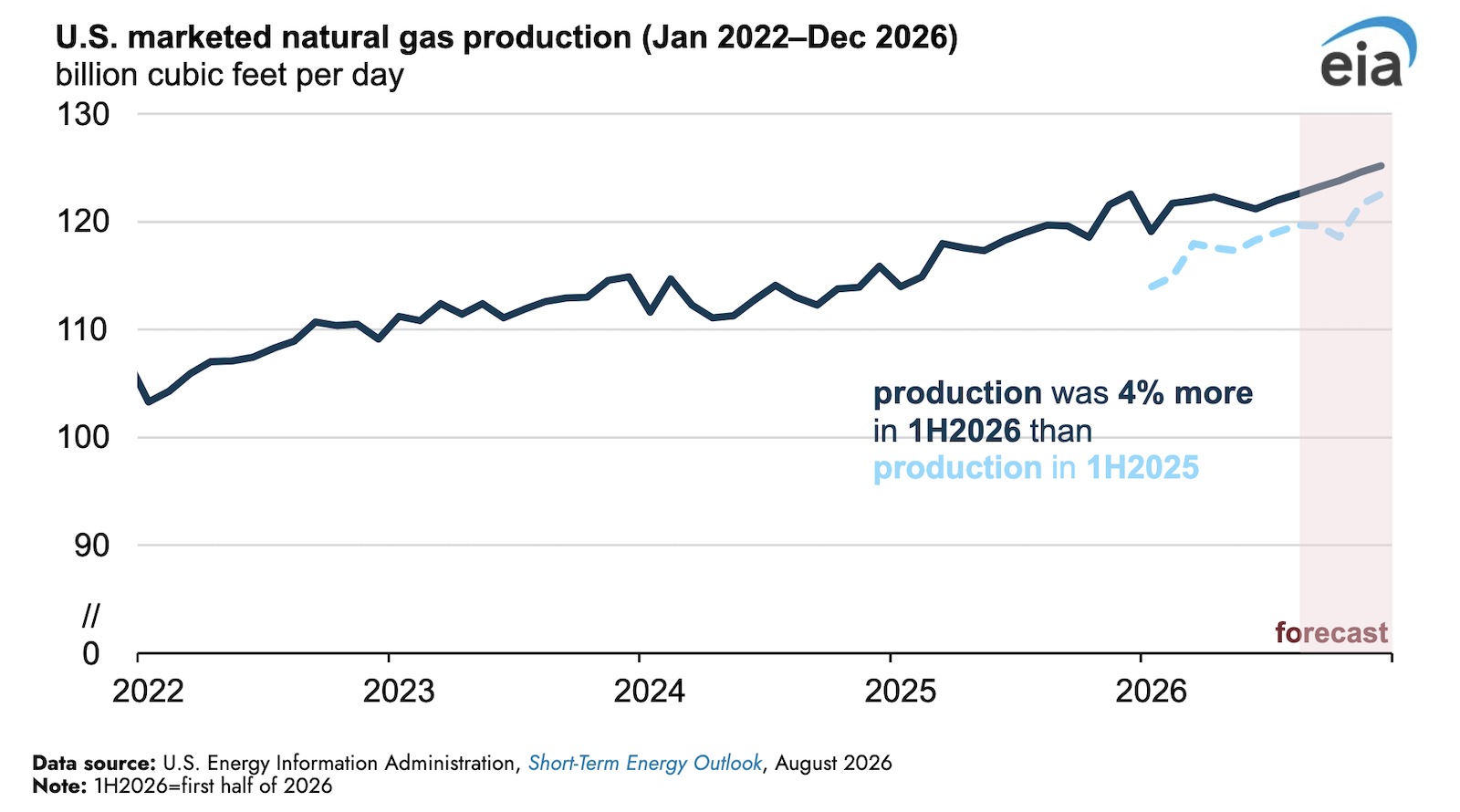
The United States is on pace to achieve record natural gas production this year, according to forecasts released in the August Short-Term Energy Outlook. Marketed output is expected to average 122.5 billion cubic feet per day across 2026, exceeding the prior benchmark of 118.5 billion cubic feet per day established in 2025.
During the first half of this year, production averaged 121.3 billion cubic feet per day, representing a 4% increase compared to the corresponding period in the prior year. Regional expansion has concentrated in two primary areas: the Permian Basin spanning Texas and New Mexico, and the Haynesville region across Louisiana and Texas. The United States has maintained its position as the world’s largest natural gas producer since 2009.
Permian Basin output is anticipated to grow 6% year-over-year to 29.2 billion cubic feet per day in 2026. Production in this region is closely tied to crude oil extraction, with natural gas captured as a byproduct. West Texas Intermediate crude oil prices averaged $84 per barrel through July of this year, substantially exceeding the regional breakeven costs reported by industry operators at $69 per barrel for the Midland Basin and $63 per barrel for the Delaware Basin. These elevated oil prices have supported continued drilling activity and corresponding increases in both crude oil and natural gas volumes.
Haynesville production has shown accelerating growth, rising 7% during the first half of 2026 compared to the prior year period, with annual growth forecast at 9%. The region operates differently from the Permian, with operators drilling specifically for natural gas rather than as an associated product. Haynesville development is therefore influenced primarily by natural gas prices at the Henry Hub benchmark. Forecasts indicate a modest 2% decline in this benchmark to an average of $3.44 per million British thermal units for the year, a level that maintains economic viability for drilling despite the region’s greater depth and higher development costs. The area’s proximity to liquefied natural gas export terminals and major industrial consumers along the Gulf Coast continues to attract active drilling operations.
Article Attribution | Read More at Article Source
Article summary produced by Claude AI