

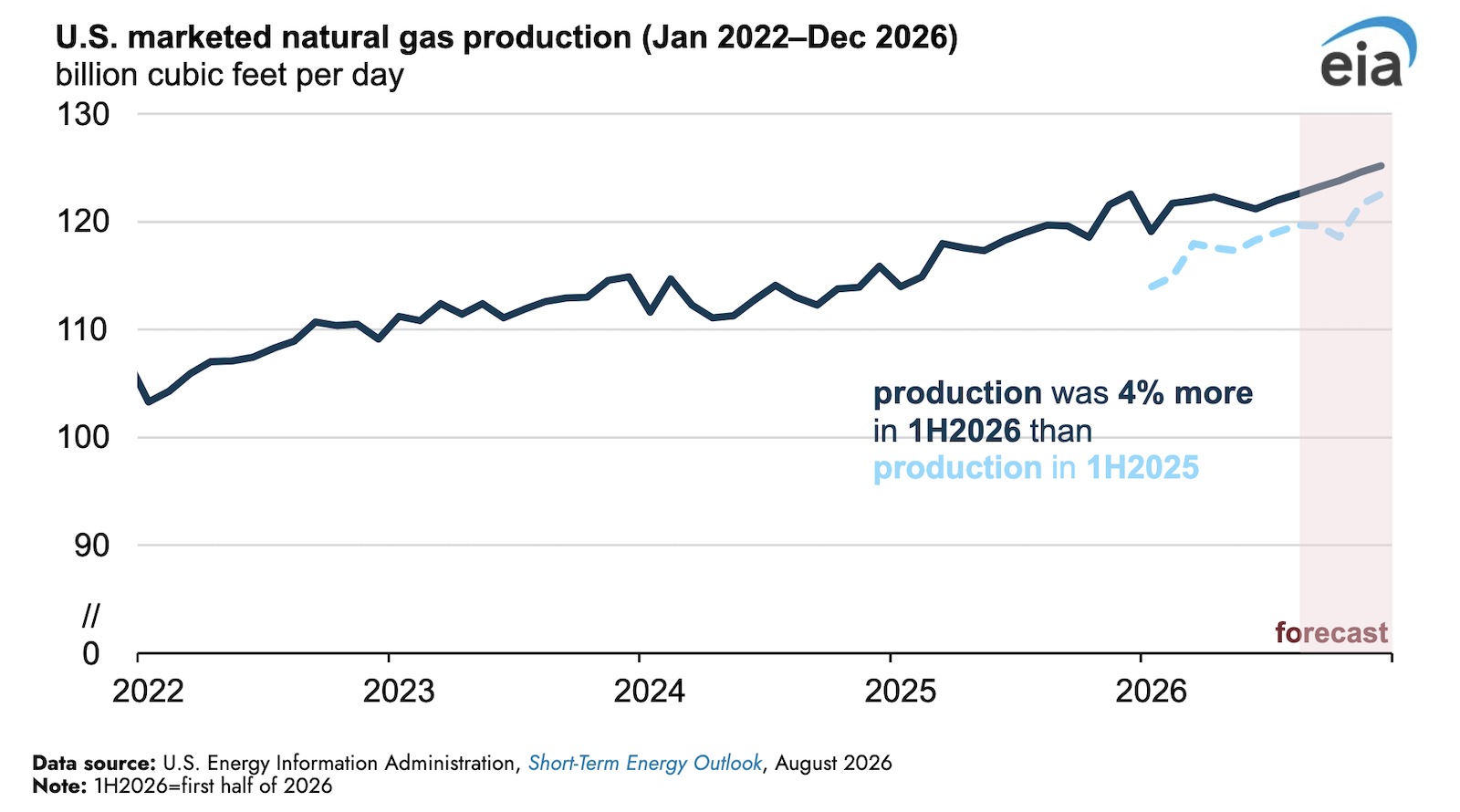
The United States is on track to set a new natural gas production record this year, according to the latest Short-Term Energy Outlook. Marketed production is projected to average 122.5 billion cubic feet per day across 2026, eclipsing the 118.5 billion cubic feet daily achieved in 2025.
Data from the first half of this year shows production averaging 121.3 billion cubic feet daily, representing a 4 percent increase compared to the same period last year. The growth is concentrated in two primary regions: the Permian basin spanning Texas and New Mexico, and the Haynesville region located in Louisiana and Texas. The country has maintained its position as the world’s largest natural gas producer continuously since 2009.
In the Permian, output is forecast to reach 29.2 billion cubic feet daily in 2026, up 6 percent from the prior year. Production in this region is largely driven by natural gas extracted alongside crude oil during petroleum extraction operations. With West Texas Intermediate crude prices averaging $84 per barrel through July 2026—above the breakeven prices of $63 to $69 per barrel reported by industry operators—drilling activity remains economically viable. Additionally, the gas-to-oil ratio in the region continues to rise as reservoir pressure declines over time, making natural gas easier to extract.
The Haynesville region is experiencing equally robust growth, with a 7 percent production increase in the first half of the year. Full-year production is forecast to rise 9 percent this year. Unlike the Permian, Haynesville drilling focuses primarily on natural gas rather than oil, making the operation sensitive to natural gas prices. The region’s deep formations, ranging from 10,500 to 13,500 feet below the surface, carry higher development costs. However, forecasts indicate the Henry Hub benchmark price will average $3.44 per million British thermal units in 2026—a 2 percent decline—which continues to support economically viable operations. Proximity to liquefied natural gas export facilities and industrial consumers along the Gulf Coast further incentivizes continued drilling activity.
Article Attribution | Read More at Article Source
Article summary produced by Claude AI