

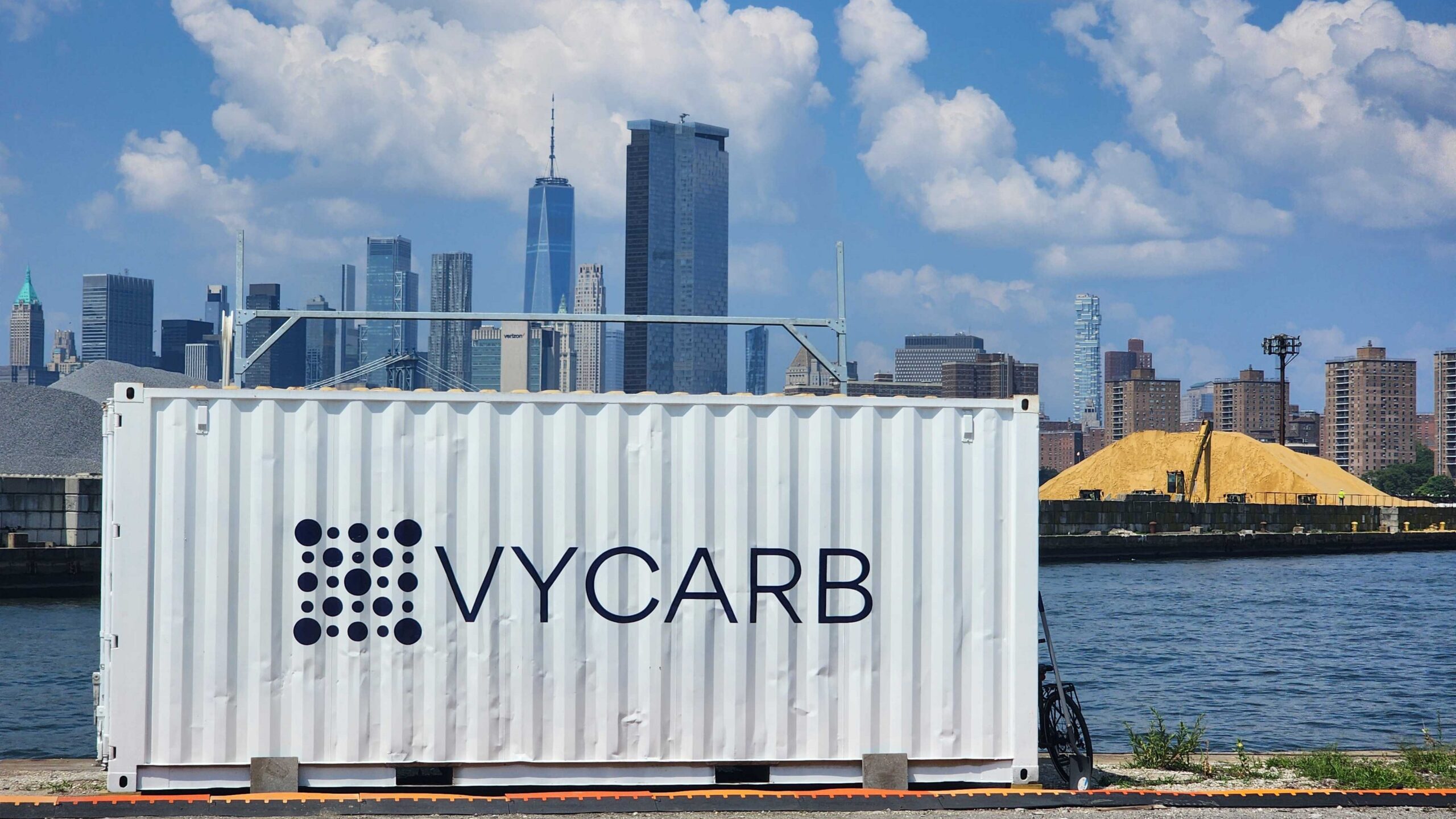
Vycarb, a Brooklyn-based company founded in 2022, has achieved a significant advance in carbon capture and storage technology by demonstrating the ability to store low-purity carbon dioxide directly in seawater. The company is currently operating a pilot facility at the Brooklyn Navy Yard on the East River, with results showing promise for larger-scale commercialization.
The core innovation involves converting CO2 into stable dissolved bicarbonate using ocean-based chemistry and real-time sensor technology. Traditional carbon capture requires expensive purification of CO2 before storage in geologic formations, a process that limits the technology’s practical applications. Vycarb’s approach eliminates the need for purification by using alkaline minerals as a feedstock with minimal power requirements. Recent testing demonstrated that the system can incorporate 99 percent of CO2 gas into water at just 50 percent purity levels, with 85 percent converting to soluble bicarbonate that remains stable upon discharge. The company has achieved even lower purity levels in laboratory conditions and aims to validate operation at 10 percent purity in upcoming field trials.
The technology has potential applications across multiple industrial sectors where point-source emissions occur. The output water has a pH around 7.5, slightly more alkaline than surrounding seawater, which could improve water quality in acidic coastal areas without reaching concentrations that would harm marine life. The company is also investigating interactions with other industrial emissions such as nitrogen dioxide.
Multiple revenue streams support the commercial viability of Vycarb’s approach. The U.S. 45Q tax credit offers $85 per metric ton for captured and stored CO2, while voluntary carbon credits trade at approximately $300 per ton. Additional incentives exist through clean fuel credits, international programs such as Denmark’s CCS fund, and carbon pricing mechanisms in jurisdictions including Singapore, the European Union, and California. Independent validation of results is underway as the company prepares to scale the technology for commercial deployment.
Article Attribution | Read More at Article Source
Article summary produced by Claude AI