

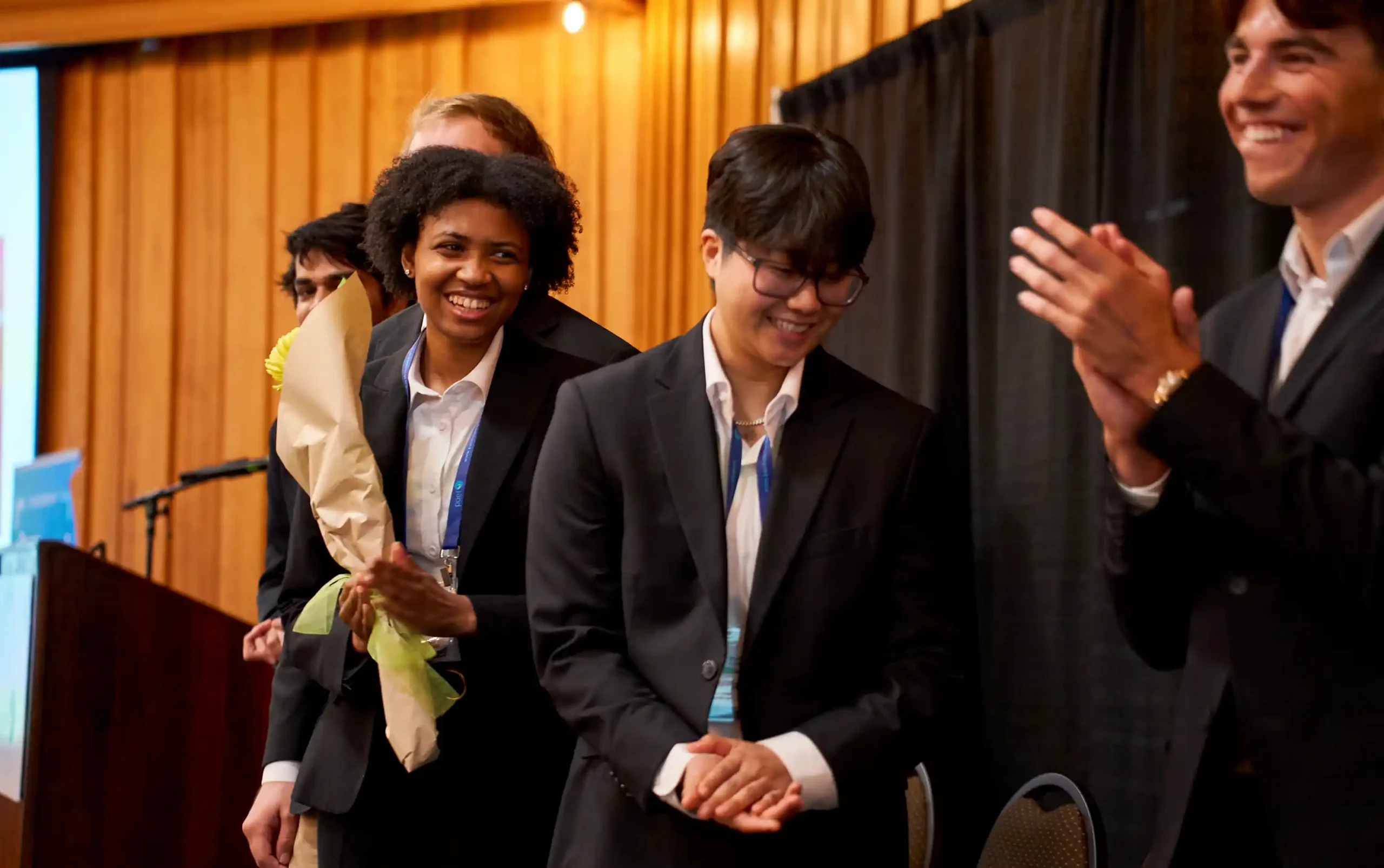
The 2026 Hydropower and Marine Energy Collegiate Competitions concluded with Cal Poly taking the grand prize at the fourth annual Hydropower Collegiate Competition finals held in Green Bay, Wisconsin, while USC secured top honors at the seventh annual Marine Energy Collegiate Competition finals in Portland, Oregon. Both events are organized by the National Laboratory of the Rockies and funded by the U.S. Department of Energy’s Hydropower and Hydrokinetic Office.
The 11 teams competing in the hydropower finals presented technologies developed over the course of the preceding year to address industry challenges including adding power to non-powered dams, incorporating pumped storage hydropower into existing reservoirs, and developing in-conduit hydropower systems. Cal Poly’s winning entry focused on extracting energy from a pressure-reducing station within the Sacramento Suburban Water District. Southern Utah University placed second, with Purdue University and Northern Arizona University tying for third. The event was held during a regional meeting organized by the National Hydropower Association and the Midwest Hydropower Users Group.
The marine energy competition featured a record-setting 24 teams competing during the Ocean Renewable Energy Conference in Portland. This year marked the introduction of a two-tiered format, with teams able to enter either the Megawatt League or Kilowatt League to reduce barriers to participation. USC, competing in their first year, won with their modular oscillating wave column designed to retrofit onto existing breakwaters for energy production. University of Washington finished second, and Cal Poly claimed third place in the Megawatt League.
A record 45 teams were selected for the 2027 competitions across both events, with 15 teams selected for the hydropower competition and 30 teams for the marine energy competition. Officials attributed the surge in interest and participation to growing momentum in both fields and expanding career opportunities in water power innovation and development.
Article Attribution | Read More at Article Source
Article summary produced by Claude AI