

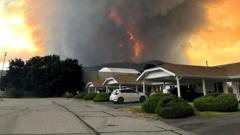
The Bald Range wildfire erupted on Friday in the Okanagan region of British Columbia, expanding to 53 square miles within hours and prompting one of the largest evacuations in the area’s recent history. More than 12,000 residents remain under evacuation orders as of Monday, with officials continuing to assess property damage. The fire remains uncontrolled, and authorities have warned that forecasted dry lightning, elevated temperatures, and strong winds could lead to new ignitions and further spread.
The region has experienced severe drought conditions in recent years, with Okanagan Lake reaching its lowest level since 1992 as of July. This environmental backdrop has contributed to widespread fire activity across the province, with more than 100 wildfires burning in British Columbia as of Monday, including 70 that ignited within the preceding week. Provincial Premier David Eby declared a state of emergency over the weekend, emphasizing the rapid pace at which fires are advancing through communities.
Long-time residents of the area expressed shock at the speed and intensity of this particular fire. Evacuees reported that the wildfire approached their properties with extraordinary rapidity, leaving minimal time for escape. One casualty was reported when an 80-year-old died while attempting to flee the fire. The Bald Range wildfire follows another recent fire in the region, the Bradley Creek fire, which destroyed more than 200 homes and is now being contained after extensive suppression efforts.
The situation in the Okanagan reflects broader wildfire challenges across western North America. In nearby Washington state, more than 65,000 people were forced to evacuate due to drought-driven fires. Internationally, Europe has also experienced significant fire activity this summer, with France experiencing its worst fire season in two decades and Madrid reporting record-breaking fire activity. Researchers have linked the increasing intensity and frequency of wildfires to climate change, which has created hotter and drier conditions conducive to fire spread.
Article Attribution | Read More at Article Source
Article summary produced by Claude AI