

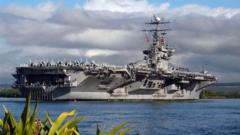
US Navy veteran Jonny Burnell spent 111 days aboard the USS Carl Vinson during 2001, serving as a military photographer that gave him unusual access throughout the ship. During his deployment, he observed a visible change in crew morale, describing a progression from initial enthusiasm to what he characterized as psychological deterioration and emotional exhaustion among sailors.
Currently, conditions aboard the USS Abraham Lincoln have drawn scrutiny, with the carrier deployed as part of US-Iran military operations since 11 December. Reports from military publications including Military Times and Stars & Stripes have documented allegations of food shortages, plumbing failures, and crew exhaustion, with families expressing concern about sailors’ mental health. Some military officials and veterans dispute the severity of these accounts, with retired Navy Lt Commander Steve Rogers characterizing media reports as largely exaggerated. However, Admiral Brad Cooper of US Central Command acknowledged that while the Lincoln has among the lowest mental health cases of active carriers, extended service at sea remains “uniquely challenging and tough.”
A CNN crew that visited the ship during July found food was adequate at that time, though some crew members reported having rationed supplies over preceding months and losing significant weight. The replacement vessel USS George Washington, scheduled to arrive within approximately a week, carries its own history of mental health concerns, including a 2022 investigation into suicides while docked.
Mental health experts attribute psychological strain aboard ships to prolonged isolation, uncertainty, boredom alternating with extreme alertness, and limited visibility into mission objectives or deployment timelines. Dr Harold Kudler, former head of mental health policy for the US Veterans Administration, notes these factors can be particularly overwhelming in extended naval operations. Burnell emphasized that many crew members assigned to lower decks have minimal opportunity to access the top deck or see daylight, intensifying the psychological burden of extended confinement.
Article Attribution | Read More at Article Source
Article summary produced by Claude AI