

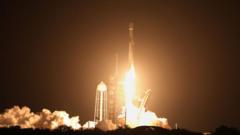
Scientists anticipate that an upper stage section of a SpaceX Falcon 9 rocket will strike the lunar surface on 5 August, according to Nasa’s Centre for Near-Earth Object Studies. The rocket component, which has been drifting through space at roughly 2.43 kilometres per second, originated from a launch in January 2025 that carried lunar landers and scientific equipment as part of a US and Japanese mission. Nasa confirmed that the collision poses no threat to Earth and stated the agency will monitor the impact site for scientific purposes.
The object in question comprises the upper stage of the Falcon 9, roughly equivalent to a five-storey building and weighing at least 4,000kg. Astronomer Bill Gray, who initially identified the rocket’s trajectory toward the Moon, predicts the impact will occur near the Einstein Crater on the Moon’s sunlit side and create a crater measuring more than 17 metres in diameter. The collision is expected at approximately 02:35 EDT on Wednesday.
Scientists anticipate the impact will produce a dramatic dust plume that may reach heights of 50 kilometres or more, a spectacle more visually impressive than comparable explosions on Earth due to the Moon’s lack of atmosphere and lower gravity. While the event will not be visible to the naked eye from Earth, observers with sophisticated telescopes may detect a flash from the Moon’s surface. Multiple observation efforts are being coordinated, including tracking by large telescopes in the Americas, Nasa’s Lunar Reconnaissance Orbiter, South Korea’s Danuri probe, and a citizen-science initiative inviting amateur astronomers to document the event.
The accidental collision presents researchers with a valuable opportunity to study lunar impacts. By analyzing the dust plume’s behaviour—including its volume, height, and dispersal patterns—astronomers hope to refine their models of how impacts affect the Moon and potentially gather information about subsurface composition at the impact site. Experts have also cited the incident as an illustration of growing concerns regarding space debris, noting that approximately 54,000 objects larger than 10 centimetres currently orbit Earth, with roughly 17,000 tonnes of human-made material launched into space since the Space Age began in 1957.
Article Attribution | Read More at Article Source
Article summary produced by Claude AI