

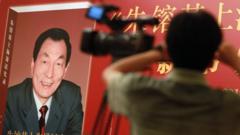
China observed a low-key state funeral for former Premier Zhu Rongji on Tuesday, with no released footage despite the attendance of senior leaders including President Xi Jinping. Zhu, who died of an illness last week at age 97, served as China’s premier from 1998 to 2003 and is regarded as a significant economic reformer. He was cremated at Babaoshan Revolutionary Cemetery, an exclusive burial site reserved for high-ranking officials and other notable figures.
The Chinese government has moved to restrict public expressions of mourning online, including removing an essay by economist Zhao Jian that nostalgically recalled Zhu’s era as a period when people had clear prospects despite limited material comforts. State media has portrayed Zhu as an “outstanding member” and “loyal Communist fighter,” yet authorities appear concerned that public grieving could transform into subtle criticism of current governance. This caution reflects historical precedent: deaths of former Premier Zhou Enlai in 1976 and former party general secretary Hu Yaobang in 1989 triggered widespread public mourning that evolved into demonstrations.
Zhu’s death coincides with the Communist Party’s commemoration of former President Jiang Zemin’s birth centenary, with whom Zhu served during China’s rapid economic expansion period. Their era, spanning from 1998 to 2003, encompassed significant structural reforms including closure of unprofitable state enterprises, transformation of housing markets, navigation of the Asian financial crisis, and China’s accession to the World Trade Organization in 2001. Both leaders became known for their relatively informal public personas and direct communication style, which contrasts sharply with the carefully controlled media presentations of current leadership.
Among Chinese citizens, nostalgia has emerged for the reform period’s apparent trajectory toward greater international engagement and personal freedoms. This sentiment stands in tension with President Xi’s emphasis on centralized state control, strategic industries, and technological self-reliance. In a recent address, Xi framed current leadership as the continuation of his predecessors’ political legacy while advocating heightened vigilance and struggle against external challenges, effectively positioning the current policy direction as their intended outcome rather than a departure from their vision.
Article Attribution | Read More at Article Source
Article summary produced by Claude AI