

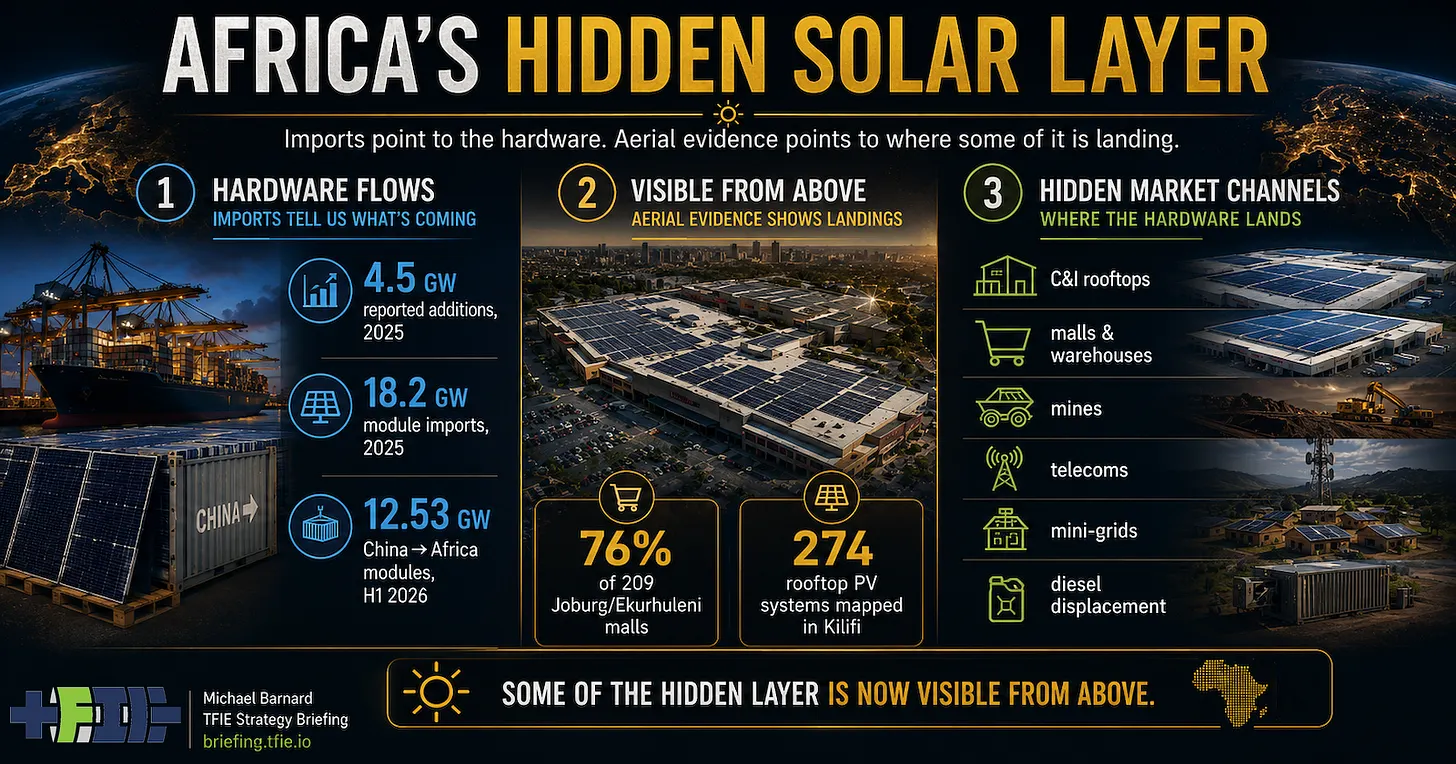
Africa’s official solar capacity additions of approximately 4.5 gigawatts in 2025 stand in stark contrast to documented module imports of 18.2 gigawatts that same year, indicating a substantial gap between hardware entering the continent and reported operational capacity. Additional Chinese solar modules totaling 12.53 gigawatts were shipped to African markets during the first half of 2026, further widening the discrepancy and prompting investigation into where this equipment is actually being deployed.
Satellite imagery analysis provides emerging evidence that the imported modules are being installed, particularly on commercial rooftops. A study examining 209 shopping malls in South African cities found that 76 percent had rooftop solar installations, suggesting that large commercial properties with significant daytime electricity demand and financial capacity are leading the adoption wave. These installations reflect economic incentives including unreliable grid supply, elevated electricity costs, and the declining price of solar modules and battery storage alongside persistent diesel expenses.
The distribution pattern appears to differ from solar booms observed in other regions. Rather than following Pakistan’s model of widespread residential rooftop coverage, Africa’s emerging solar deployment appears concentrated in commercial, industrial, and institutional applications where businesses install systems to address power reliability and cost concerns. This concentration aligns with fundamental economic drivers, as commercial operators face direct financial impacts from grid disruptions and expensive alternative power sources.
Satellite evidence has inherent limitations as a measurement tool. Small residential installations, rural systems, agricultural pumps, and equipment obscured by vegetation remain difficult to identify from aerial imagery. Additionally, visible panels do not confirm that supporting infrastructure including inverters, batteries, and electrical systems are operational. The convergence of multiple measurement approaches—customs data, satellite imagery, market intelligence, and behind-the-meter estimates—provides stronger evidence than any single data source.
The implications of this measurement gap extend beyond statistical accuracy. Large-scale solar and battery adoption by commercial and industrial customers materially affects grid demand patterns, diesel consumption, utility revenues, and industrial competitiveness. Official statistics may be systematically underreporting the pace of Africa’s energy transition, particularly in distributed, behind-the-meter systems that conventional capacity tracking methods struggle to capture accurately.
Article Attribution | Read More at Article Source
Article summary produced by Claude AI