

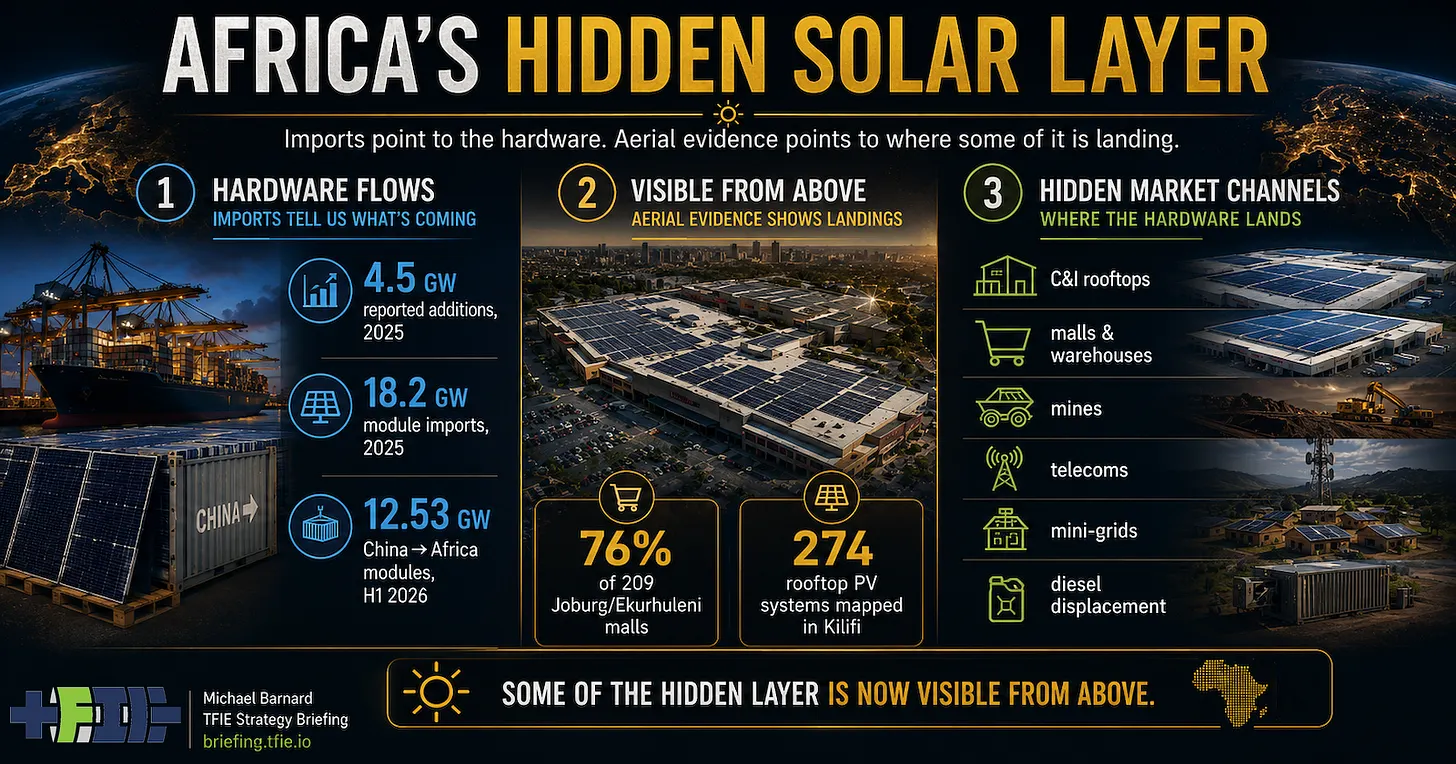
Africa’s solar deployment appears to be outpacing official statistics, with a substantial gap between imported solar hardware and reported capacity additions. During 2025, the continent imported approximately 18.2 gigawatts of solar modules while official records showed only 4.5 gigawatts of new solar capacity. Early in 2026, an additional 12.53 gigawatts of finished Chinese modules were shipped to African markets, further widening the discrepancy between imports and reported installations.
The missing solar capacity appears to be distributed across behind-the-meter installations, where businesses, institutions, and households are deploying panels independently rather than through utility-scale projects captured in official statistics. Market conditions have created strong incentives for these decentralized installations, including low Chinese module prices, declining battery costs, expensive and unreliable diesel generators, and grid instability that affects mining operations, commercial facilities, telecommunications providers and industrial users.
Satellite imagery is beginning to corroborate the existence of this hidden deployment layer. Analysis of 209 shopping malls in South Africa’s Johannesburg and Ekurhuleni areas found rooftop solar installations on 76 percent of them. These commercial properties represent the types of customers most likely to invest in their own power systems, given their large roofs, significant daytime electricity consumption, financial capacity for equipment purchases, and direct exposure to grid unreliability and high power costs.
The emerging African pattern appears distinct from Pakistan’s rooftop-solar expansion, which occurred across both residential and commercial neighborhoods. African installations currently show greater concentration in commercial, industrial and institutional applications rather than widespread residential coverage. This reflects underlying economic incentives, with businesses prioritizing protection against outages and high operating costs rather than residential consumers collectively covering urban areas in panels.
Satellite imagery has limitations as a measurement tool, as small residential systems, rural installations, telecom towers, agricultural pumps and obscured panels remain difficult to detect from above. However, the convergence of multiple independent data sources—customs records, rooftop imagery, and market-structure analysis—suggests that official statistics significantly undercount Africa’s solar capacity additions, particularly for distributed, off-grid and behind-the-meter systems that remain invisible to conventional reporting mechanisms.
Article Attribution | Read More at Article Source
Article summary produced by Claude AI