

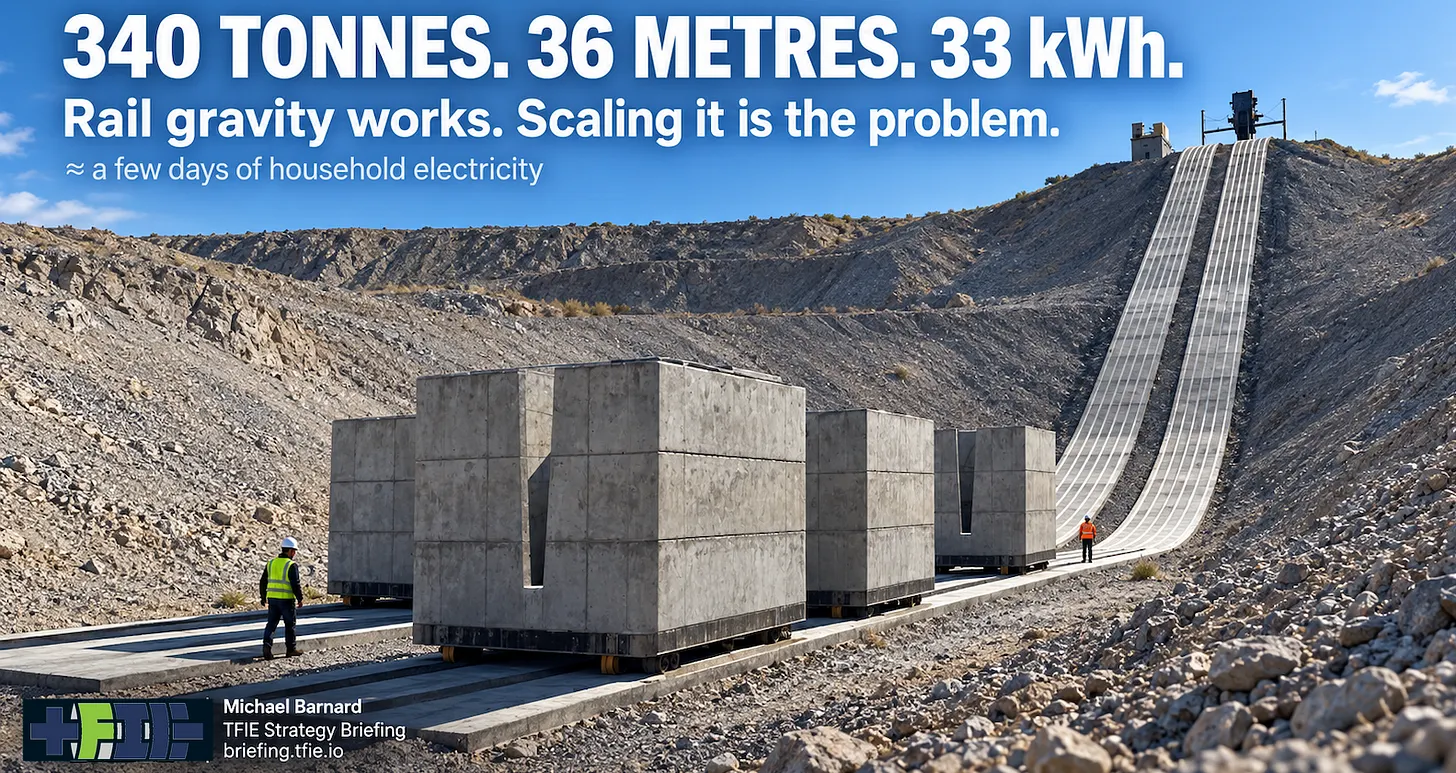
ARES North America has completed sufficient operational testing of its GravityLine gravity storage system at Gamebird Pit in Nevada to highlight significant technical and commercial challenges. According to documentation from Sandia National Laboratories, the system uses two mass cars weighing approximately 340 tonnes that climb a slope of roughly 55 percent grade through approximately 36 metres of elevation, storing only about 33 kilowatt-hours of gross gravitational energy. While the pair of cars can briefly produce several megawatts during descent, the limited vertical movement constrains total energy availability.
The core limitation stems from fundamental physics: stored gravitational energy equals mass multiplied by gravity and elevation. When evaluating the system’s potential for commercial grid-scale storage—such as a 400 megawatt-hour installation operating at 20 megawatts for twenty hours—the requirements become substantially more demanding. The system would require hundreds of thousands of tonnes of stored mass distributed among large purpose-built carriers, necessitating storage areas at both elevations, operating paths, stationary drives, transfer systems, controls, maintenance access and redundancy provisions. Additionally, a custom heavy manufacturing plant for rail, cement, and related materials would need to be constructed and maintained at each site.
Rail gravity storage presents disadvantages compared to alternative long-duration storage technologies. Pumped hydroelectric systems use equivalent gravitational physics but handle stored water more efficiently through irregular reservoirs without requiring individual chassis, rollers and bearings for each mass increment. Lithium-ion battery systems, while requiring manufactured components, are produced in standardized forms by established global supply chains rather than requiring site-specific industrial production. Recent battery procurement initiatives in Europe have demonstrated that lithium-ion systems can now compete effectively at durations previously considered outside their practical range.
Embodied carbon considerations further weigh against rail gravity storage. While the rock itself carries minimal carbon content, the high-quality steel and Portland cement required for the massive plant infrastructure, winches, rails and rail cars represent substantial carbon burdens. Physics constraints mean that reducing elevation requirements simply multiplies the necessary mass proportionally, multiplying embodied carbon by equivalent factors. These characteristics position rail gravity storage as neither a viable climate solution nor a commercially competitive energy storage alternative.
Article Attribution | Read More at Article Source
Article summary produced by Claude AI