

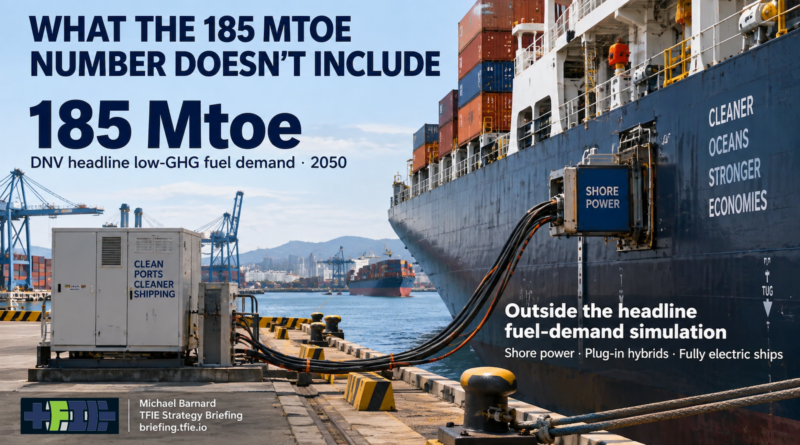
DNV released its Maritime Forecast to 2050, estimating that internationally operating ships above 400 gross tonnes will require approximately 185 million tonnes of oil equivalent of low-greenhouse-gas fuel annually by 2050. This projection assumes the strongest global-regulation scenario and represents roughly 7.7 to 7.8 exajoules of energy, pointing to a substantial future market for biofuels, synthetic fuels, and other alternatives to conventional marine fuels.
A significant aspect of DNV’s analysis involves the treatment of electrification options. The report acknowledges that shore power, plug-in hybrid systems, and fully electric vessels could make material reductions to future fuel demand. However, these technologies are not included as competing fuel-demand reduction pathways in the primary simulations that generated the headline figures. DNV demonstrates awareness of battery technology adoption, noting more than 1,500 battery-equipped vessels currently in operation and another 371 on order, with ferries comprising the bulk of deployed units alongside emerging applications in support vessels, tugs, coastal cargo ships, and some cruise vessels.
The analytical framework treats efficiency measures as central to maritime decarbonization, with stronger regulatory signals potentially reducing fleet energy consumption by up to 25 percent by 2050 through improved hull design, propeller efficiency, operational practices, and reduced steaming speeds. The report allows fuel prices and emissions constraints to influence operational behavior in consequential ways, recognizing that more expensive low-carbon fuels can change not only efficiency outcomes but also whether particular vessel operations remain economically viable when powered by conventional fuels.
A critical distinction in DNV’s approach involves the interaction between fuel costs and technology choices. When low-carbon liquid fuels become substantially more expensive than conventional marine fuel, the economics of port-call electrification and more electric vessel architectures improve correspondingly. The analysis also incorporates assumptions about future seaborne freight patterns rather than freezing current cargo structures indefinitely, accounting for potential changes in trade flows driven by broader energy system transitions affecting fossil-fuel commodity movements and other bulk cargo flows.
The practical implication of these analytical choices is that the addressable market for low-carbon shipping fuels may operate differently than current bunker markets with alternative fuel labels. Efficiency improvements act as the first intervention, direct electricity removes additional portions where vessel duty cycles permit, and structural changes in freight demands can eliminate some maritime work entirely. Only the remaining maritime energy requirement must be addressed through biological carbon sources, synthetic hydrocarbons, methanol, ammonia, or equivalent fuel pathways. The size of this residual market significantly influences how adequately biological feedstocks appear and what role electricity-intensive synthetic fuels will play in meeting future shipping energy needs.
Article Attribution | Read More at Article Source
Article summary produced by Claude AI