

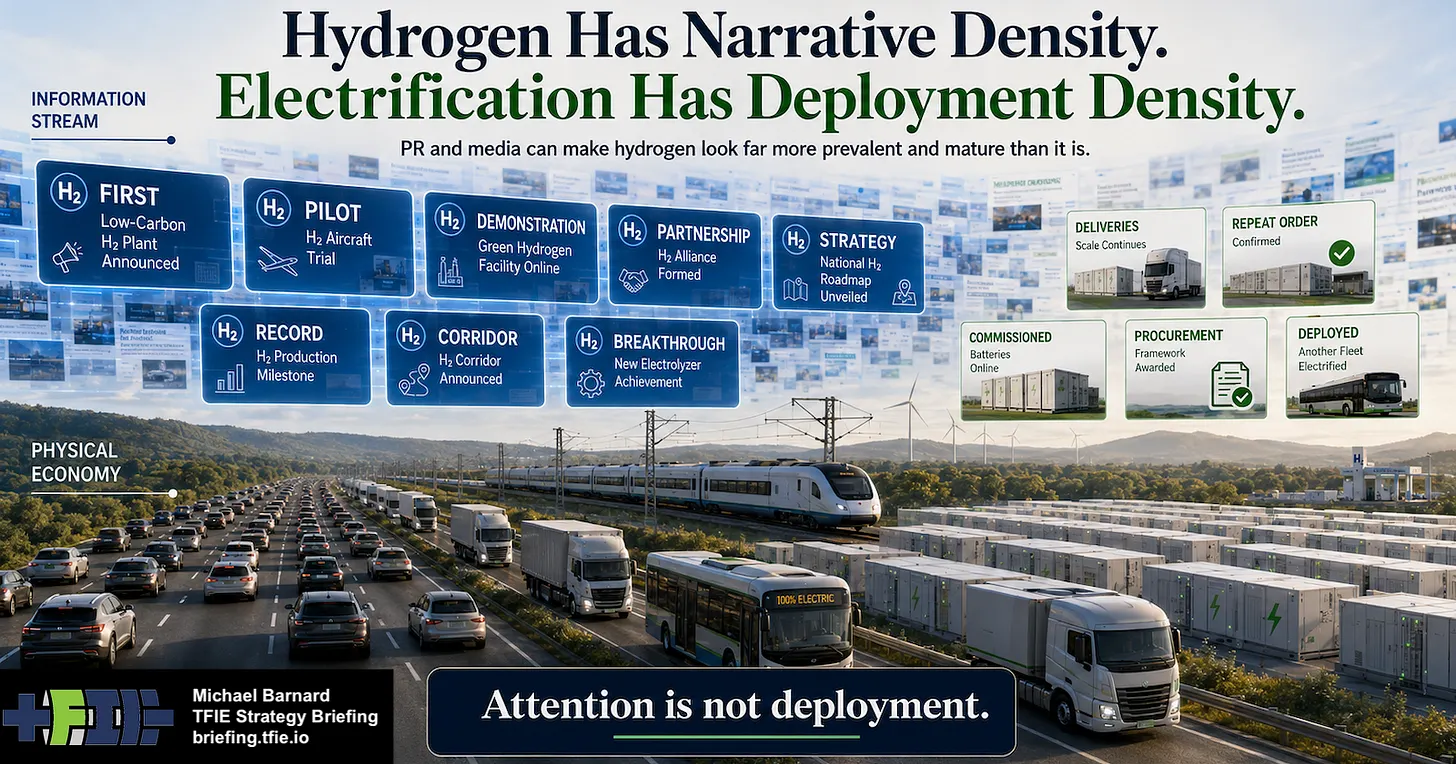
Hydrogen technology dominates energy-transition news coverage at a proportion far exceeding its real-world deployment, according to analysis of positive milestones reported between 2022 and 2025. While battery announcements numbered 206 compared to 114 for hydrogen during this period, the actual market data reveals a much starker contrast between the two technologies.
The disparity becomes evident when examining specific sectors. China operated approximately 366,000 electric heavy trucks at the end of 2025 against about 18,000 fuel-cell heavy trucks, despite announcements favoring batteries by only 1.5 to one. In transit buses, the announcement ratio was roughly 2 to 1 for batteries, yet more than 680,000 electric buses operated in China alone versus approximately 15,000 fuel-cell buses globally. Maritime shipping showed a similar pattern, with announcements separated by only two to one while actual vessel fleets demonstrated seven hydrogen-fueled ships against more than 1,300 battery-equipped vessels.
The discrepancy reaches extreme levels in grid storage, where announcements showed a nine-to-one information advantage for batteries. However, the physical market comparison showed approximately 10 megawatts of hydrogen demonstration capacity against roughly 108,000 megawatts of battery-storage additions in 2025, representing a scale difference of approximately 10,800 to one. Passenger vehicle sales further illustrate this gap, with roughly equal numbers of announcements despite approximately 16,000 fuel-cell vehicles sold against about 13 million battery-electric cars in 2025.
This distortion does not necessarily reflect false reporting or journalist credulity. Rather, news organizations organize coverage around discrete events while markets operate through continuous transactions. A single hydrogen bus deployment generates one announcement, as does a large battery bus order. Once technology becomes routine, growth occurs through purchases that lack newsworthy value. Scarcity sustains attention: a first hydrogen train or maritime demonstration remains notable simply because few examples exist. Analysis of announcement maturity showed battery events averaged higher on commercialization scales, with approximately 82 percent representing scaled deployment or repeat procurement compared to 40 percent for hydrogen events.
Investors, analysts and policymakers face challenges distinguishing genuine market formation from repeated pilots and technologies maintaining marginal commercial status despite sustained publicity. The analysis suggests implementing evidence checks and denominator discipline to properly assess which technologies represent emerging markets versus those remaining primarily in demonstration phases.
Article Attribution | Read More at Article Source
Article summary produced by Claude AI