

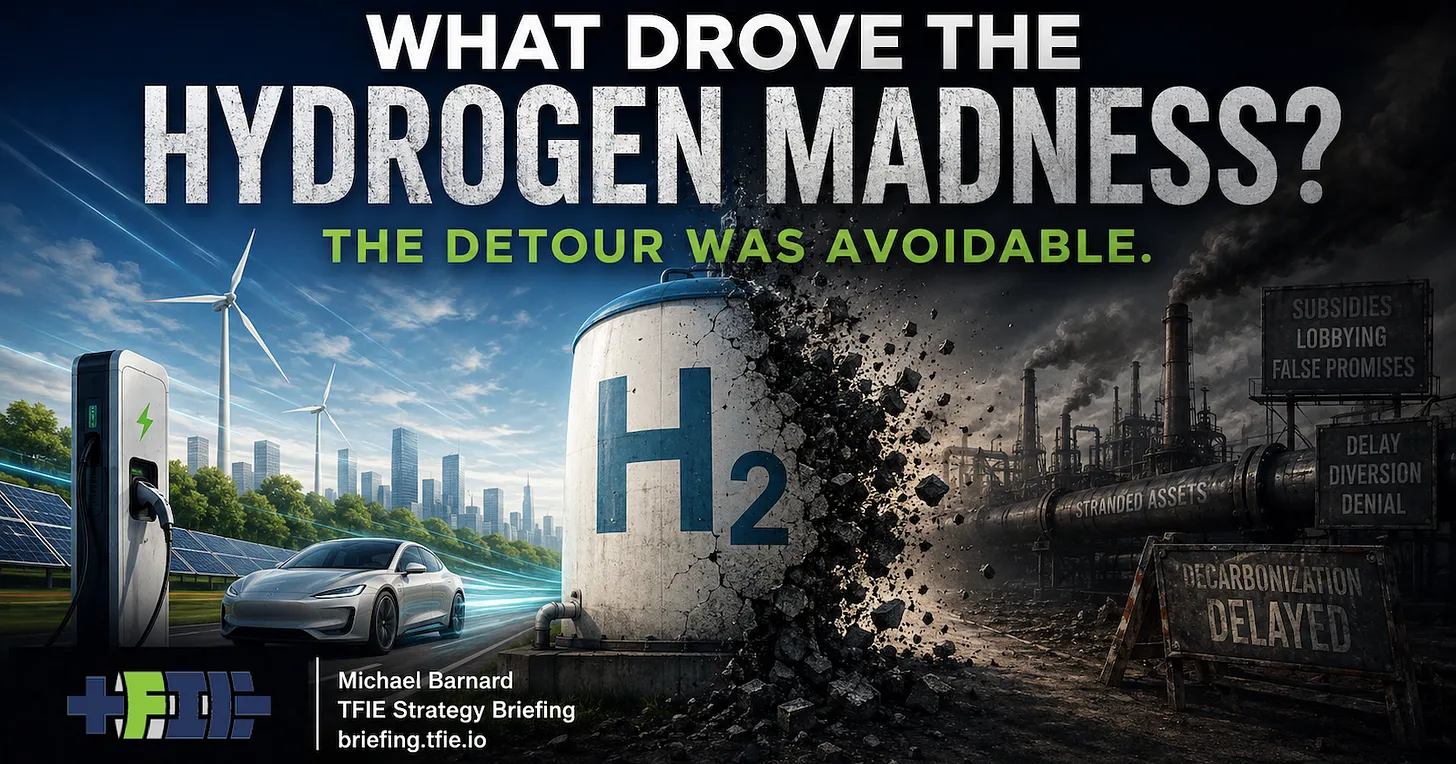
A analysis of hydrogen’s continued promotion despite increasingly evident economic and technical shortcomings reveals that institutional factors played a larger role than previously understood in sustaining support for hydrogen applications.
Thermodynamic and economic constraints on hydrogen have been apparent for years. A 2003 critique identified the inherent energy intensity of producing, compressing, transporting and storing hydrogen compared to direct electricity use. The economics present a difficult tradeoff: green hydrogen production requires extremely cheap electricity, but industrial plants need high utilization rates. Since the cheapest renewable energy is intermittent, either plants operate underutilized or electricity costs rise through overbuilding and storage solutions. By 2025, observed project costs significantly exceeded institutional forecasts, indicating the gap between theory and reality widened rather than narrowed.
Despite these visible constraints, hydrogen continued attracting support because it served institutional interests beyond energy efficiency considerations. Gas infrastructure companies faced declining strategic value in a world shifting toward direct electrification. Hydrogen offered an alternative pathway where existing reserves, pipelines, processing plants and expertise could remain valuable as blue hydrogen operations. Similarly, legacy automakers confronted competitive disadvantages from battery-electric vehicles, which shifted value away from combustion engine systems toward battery cells and software platforms. Hydrogen combustion presented a way to preserve more of incumbent industrial systems and address legitimate concerns about worker and supplier transitions, though this prioritized preserving inefficient technologies.
Governmental commitments created additional momentum. Once hydrogen targets, subsidies and infrastructure strategies were established, entire ecosystems organized around them. The European Court of Auditors found major hydrogen targets were set without sufficiently robust analysis, yet these commitments already shaped billions in investment decisions and industrial planning. Critically, a stopping rule never materialized. Each intervention—production subsidies, demand support, additional filling stations, pipeline infrastructure—could be individually justified while the fundamental question of whether hydrogen suited specific applications disappeared from consideration.
Hydrogen does have legitimate applications in decarbonizing existing ammonia and methanol production, and potentially certain iron-production pathways where the molecule itself has inherent value justifying premium costs. However, these specialized uses never required hydrogen to become a general-purpose substitute for electricity in heating, transportation or energy storage. The hydrogen pathway’s persistence reflected rational organizational self-interest producing suboptimal energy policy, compounded by institutional structures that failed to periodically reassess the foundational case for hydrogen applications as evidence accumulated.
Article Attribution | Read More at Article Source
Article summary produced by Claude AI