

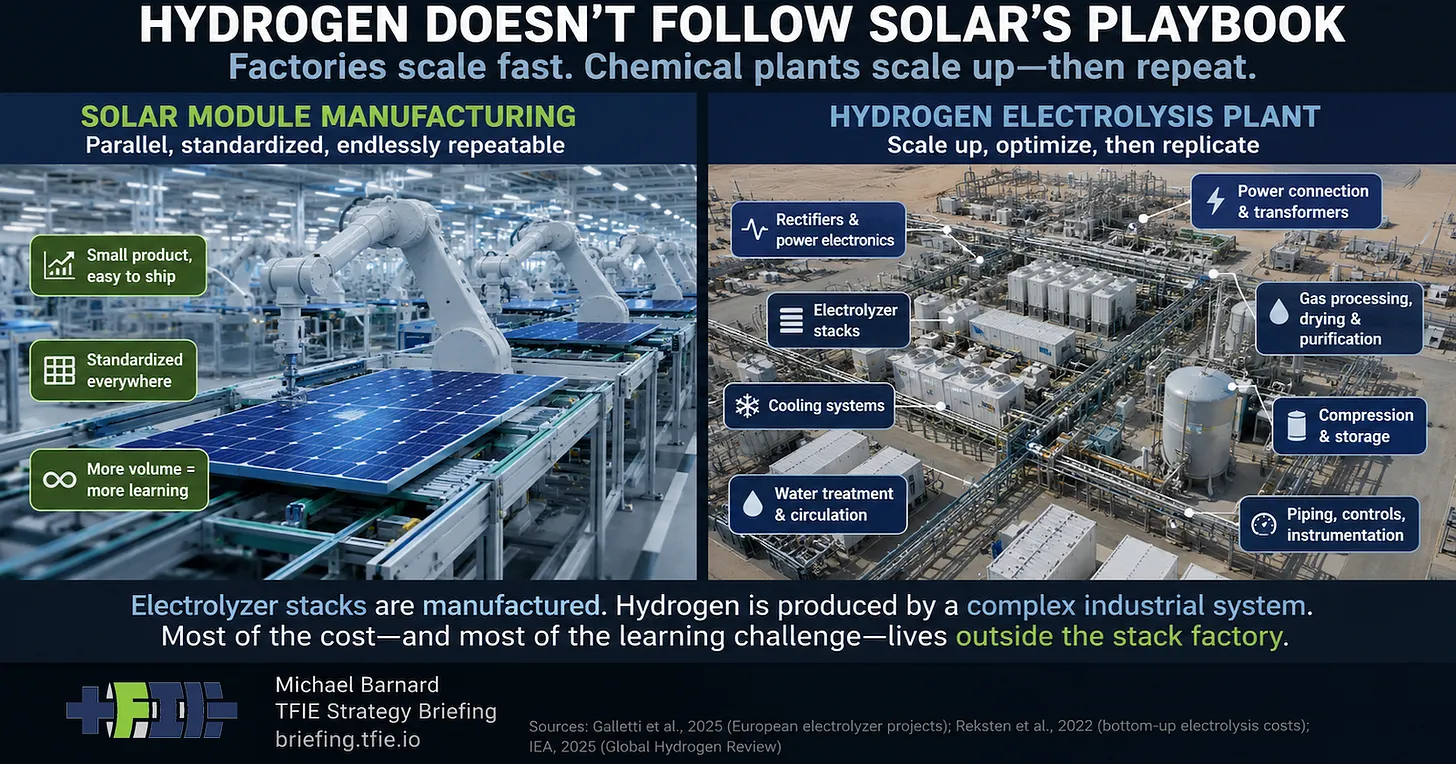
Analysts commonly employ experience curves to project future hydrogen costs, assuming that each doubling of installed capacity corresponds to proportional cost reductions observed historically in solar and battery industries. However, recent research suggests this approach may significantly overestimate cost declines for hydrogen electrolyzers and production plants.
A 2025 European study examining electrolyzer projects from 2005 onward initially showed impressive experience rates, with costs falling between 22.9% and 32.1% per capacity doubling depending on the technology type. When researchers adjusted these figures to account for project-size economies, the rates dropped substantially to between 7.3% and 17.6%, with some relationships losing statistical significance. This adjustment reveals that the raw data conflated multiple distinct cost-reduction mechanisms rather than reflecting true manufacturing learning.
The core issue involves what a capacity doubling actually represents in manufacturing terms. When electrolyzer stack sizes grow larger, a doubling of installed gigawatts may not correspond to a doubling of manufactured stacks. For example, if average stack size increases from 1 megawatt to 5 megawatts while total capacity rises from 5 to 50 gigawatts, the number of stacks produced only doubles rather than increasing tenfold. Factories gain experience, but at a slower rate than cumulative gigawatts suggest. Similar complications arise with component-level manufacturing and subassemblies, which gain experience at different rates than finished stacks.
Additional cost factors limit the applicability of steep learning curves. Electrolyzer stacks represent only 15-20% of total installed capital costs, with balance-of-plant equipment accounting for 25-30% and engineering, procurement, construction and contingency comprising over half. Even substantial cost reductions in stack manufacturing yield modest overall project savings. Other system components including compressors, civil works and electrical systems follow independent cost trajectories.
Electricity costs present another fundamental constraint, dominating variable hydrogen production expenses and remaining unaffected by manufacturing learning. Storage, compression and distribution infrastructure carry separate economics that manufacturing improvements cannot transform into mass-produced modules with solar-style cost curves. Accurate hydrogen forecasting requires separately modeling manufacturing improvements, equipment performance, equipment scaling, industrial plant economics, electricity costs, utilization rates and logistics rather than applying a single historical learning rate mechanically across decades.
Article Attribution | Read More at Article Source
Article summary produced by Claude AI