

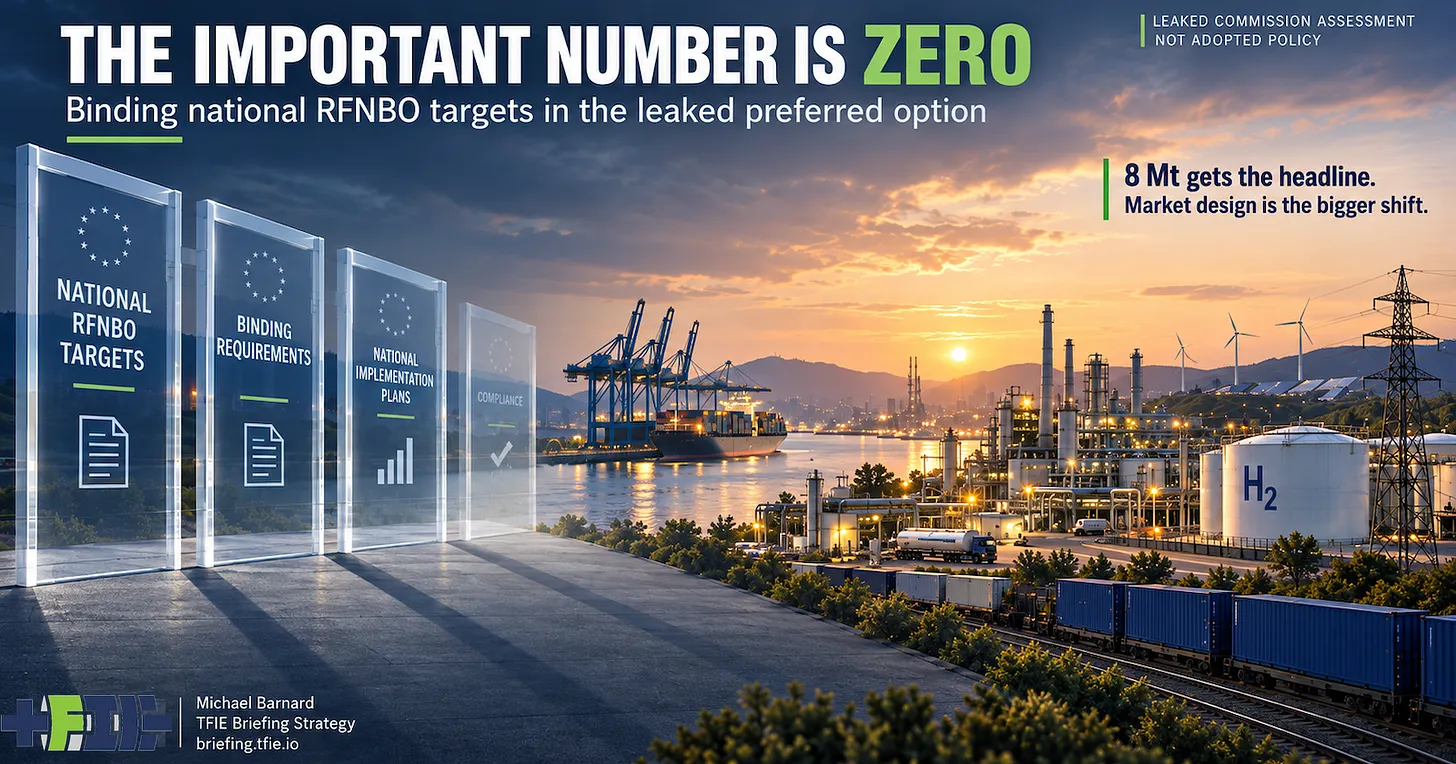
A European Commission staff impact assessment obtained in draft form indicates a significant shift in how the European Union may approach renewable hydrogen policy beyond 2030. The current Renewable Energy Directive establishes binding national quotas requiring renewable fuels of non-biological origin to comprise at least 42% of industrial hydrogen consumption by 2030 and 60% by 2035. The leaked assessment suggests these mandatory national targets would be replaced with an indicative EU-level renewable-hydrogen objective, complemented by financing measures and a credit mechanism designed to generate demand while allowing flexibility across member states.
The proposed framework represents a structural change rather than merely adjusting hydrogen consumption levels. Under the current architecture, member states must ensure specified quantities of renewable hydrogen are consumed within their borders, though market competition determines which suppliers provide that hydrogen. A credit-based system would allow renewable-hydrogen production and consumption to satisfy compliance obligations with greater flexibility across the broader EU system. The leaked assessment notes this remains a draft containing unresolved methodological elements, as the Commission continues preparing its post-2030 renewable-energy framework for a legislative proposal expected before the end of 2026.
The impact assessment models varying hydrogen scenarios for 2040, including a central case of 18 million tonnes of electrolytic hydrogen consumption, compared with eight million tonnes in a lower-hydrogen pathway and 20 million tonnes in a higher case. The assessment notes that reducing prescribed hydrogen consumption could lower electricity prices and preserve additional clean electricity for direct use, a relevant consideration given that hydrogen and direct electricity frequently compete for the same renewable generation resources. This distinction carries practical importance because converting electricity to hydrogen involves significant energy losses before accounting for compression, storage, transport and potential reconversion.
The proposal distinguishes between hydrogen as an existing industrial feedstock already essential for ammonia, refining and chemical production, versus hydrogen as a policy-selected energy carrier in applications where alternative technologies could provide the same service. The current regulatory structure limits competition by establishing consumption requirements that markets must satisfy through hydrogen, rather than determining whether hydrogen represents the most economical approach. The leaked draft does not indicate Europe plans to abandon hydrogen support entirely, as other EU regulations including ReFuelEU Aviation and FuelEU Maritime maintain hydrogen-specific requirements, while the Alternative Fuels Infrastructure Regulation requires hydrogen refuelling infrastructure deployment on designated networks.
The shift from volume-based national quotas to a credit-based compliance mechanism would theoretically allow support policies to adapt as industrial conditions change, including variations in electricity pricing, project timelines and technological developments. However, the final framework’s actual flexibility will depend on detailed implementation rules including how credits, multipliers and incentives are structured. The draft indicates Commission staff are examining an approach that maintains public support for renewable hydrogen while allowing the compliance architecture greater discretion in determining production and consumption locations, though whether this would produce lower costs or improved outcomes remains unsettled pending detailed analysis.
Article Attribution | Read More at Article Source
Article summary produced by Claude AI