

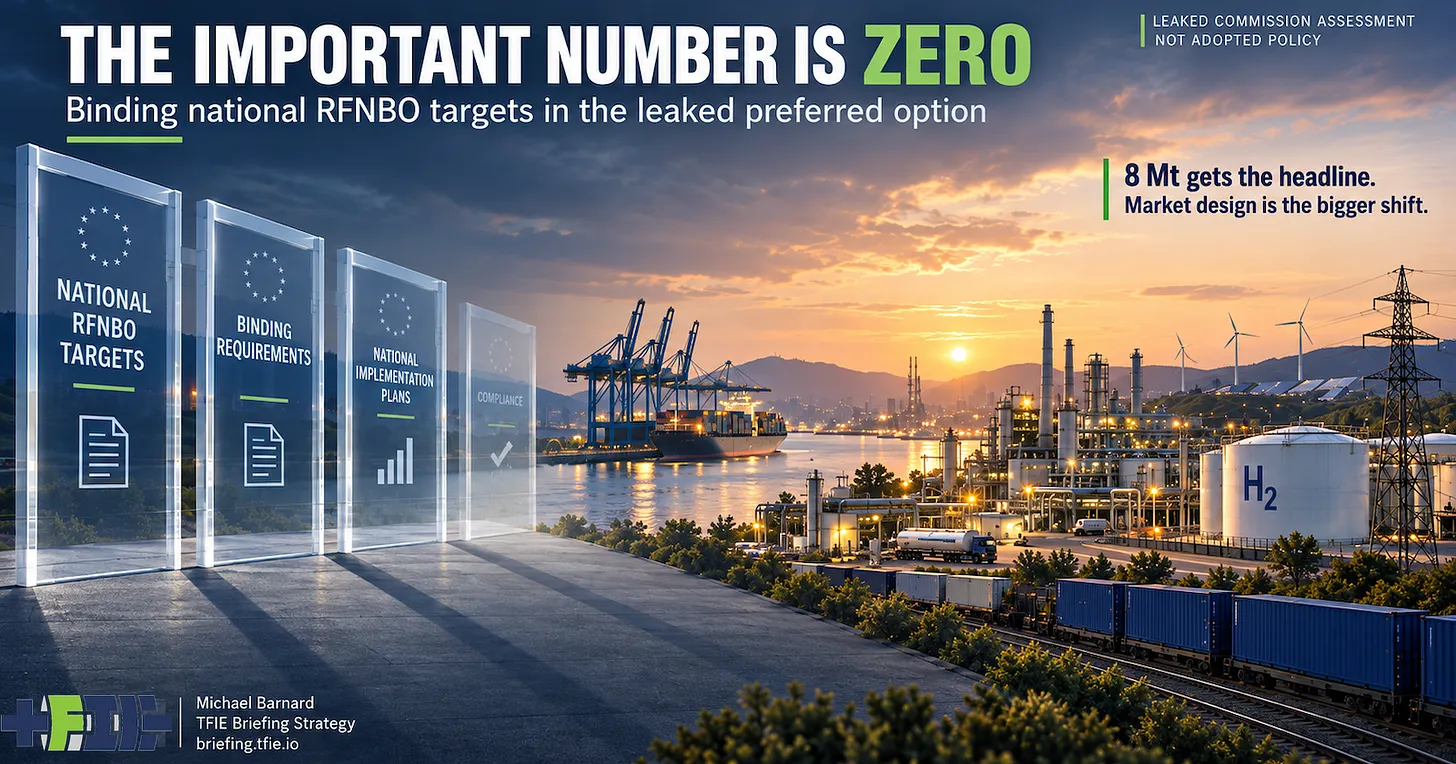
A European Commission staff impact assessment obtained in draft form suggests a significant shift in how the European Union may approach renewable hydrogen policy beyond 2030. The current regulatory framework, established through the Renewable Energy Directive, mandates that renewable fuels of non-biological origin account for specified percentages of industrial hydrogen consumption in member states. The leaked assessment indicates that binding national consumption targets for renewable hydrogen could be replaced with an EU-level indicative target paired with a credit-based compliance mechanism.
Under the proposed approach, the credit system would allow compliance obligations to be satisfied more flexibly across the European system, rather than requiring each member state to meet identical consumption requirements. This shift reflects a potential recognition that prescriptive quota systems may not adapt efficiently as industrial conditions and technology costs evolve. The assessment notes that European Commission officials are still developing the post-2030 renewable energy framework, with a legislative proposal anticipated before the end of 2026.
The leaked document also presents revised consumption projections for electrolytic hydrogen. The central scenario models 18 million tonnes of consumption in 2040, contrasted with eight million tonnes in a low-hydrogen pathway and 20 million tonnes in a high-demand case. The variations highlight ongoing uncertainty about hydrogen’s ultimate role in Europe’s decarbonization strategy, particularly given competition between hydrogen production and direct electricity use for renewable generation resources.
A key distinction in the emerging framework separates hydrogen as an existing industrial feedstock, where carbon-intensity requirements address current emissions, from hydrogen as a policy-driven energy carrier in applications where alternative technologies might achieve similar objectives. The credit-based structure could theoretically allow compliance mechanisms to respond to technological improvements and market conditions more dynamically than rigid consumption quotas. However, the assessment confirms that other hydrogen-specific policies would remain elsewhere in the European regulatory framework, including requirements in aviation and maritime sectors and infrastructure mandates.
The shift from quota-based to credit-based architecture represents a fundamental change in how Europe might support renewable hydrogen development, potentially allowing greater flexibility in determining which applications and locations receive policy support as industrial conditions and technology costs evolve.
Article Attribution | Read More at Article Source
Article summary produced by Claude AI