

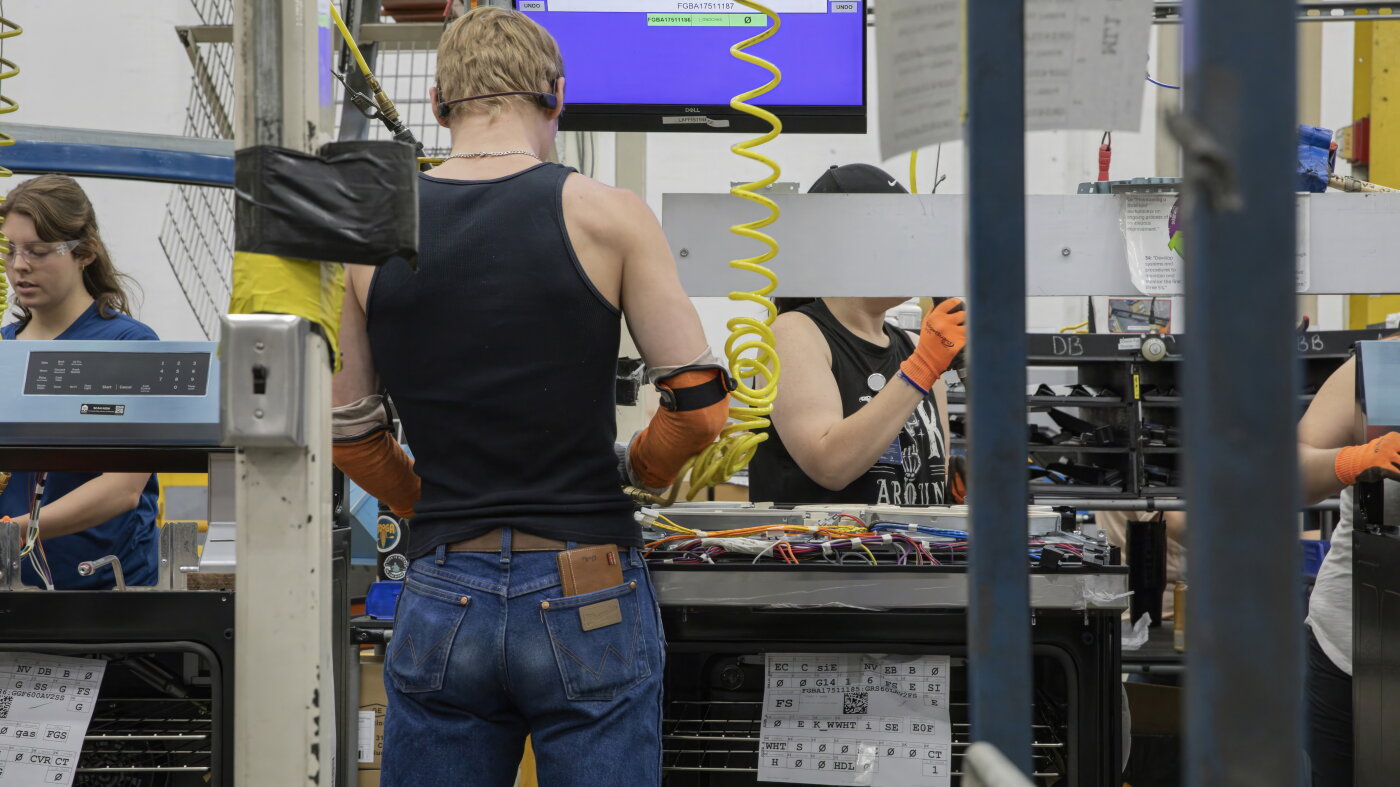
At a GE Appliances cooking appliance manufacturing facility in LaFayette, Georgia, artificial intelligence systems are being deployed across assembly lines to enhance operational efficiency and product quality. The plant utilizes AI-powered cameras and sensors positioned throughout the facility to identify defects in real time, autonomous vehicles to transport components, and robots to perform assembly tasks such as attaching glass cooktops to metal frames. When a quality control system detects an anomaly, such as an incorrect gasket installation, the affected assembly line halts automatically while an audio alert signals workers to address the issue immediately.
The facility’s leadership emphasizes that rapid problem identification and resolution are essential to manufacturing competitiveness. Plant director Tony Gabbert notes that the company aims to achieve perfect production runs daily. According to Bill Good, GE Appliances’ vice president of manufacturing, each percentage point improvement in production metrics translates to between $1.5 million and $2 million in annual savings. The company has accumulated over a decade of data from camera systems and sensors, generating millions of data lines daily that feed into the Brilliant Factory platform, which provides real-time visibility into operations across nine major appliance plants.
The analytical capabilities of AI have proven transformative for plant management and decision-making. Executives can now access AI-generated reports that not only identify emerging problems but suggest solutions. The system can detect warning signs such as overheating motors before equipment failures occur, preventing costly unplanned downtime that can cost between $300 and $500 per minute. Good, with nearly 40 years of manufacturing experience, acknowledges that AI analytical capabilities exceed human expertise while maintaining that AI replacement of human workers remains unlikely in the foreseeable future.
GE Appliances, acquired by Chinese conglomerate Haier in 2016, has recently expanded its Georgia operations by adding 600 jobs as part of a $180 million investment. Company leadership views AI-enabled efficiency improvements as essential to competing with overseas manufacturers that benefit from lower labor costs. The facility has begun using AI for staffing optimization and demand forecasting, allowing for flexible production scheduling and workforce deployment. Good characterizes the competitive environment as requiring manufacturers to be faster, more flexible, and more capable than rivals, with advanced technology serving as the primary mechanism for sustaining domestic manufacturing operations.
Article Attribution | Read More at Article Source
Article summary produced by Claude AI