

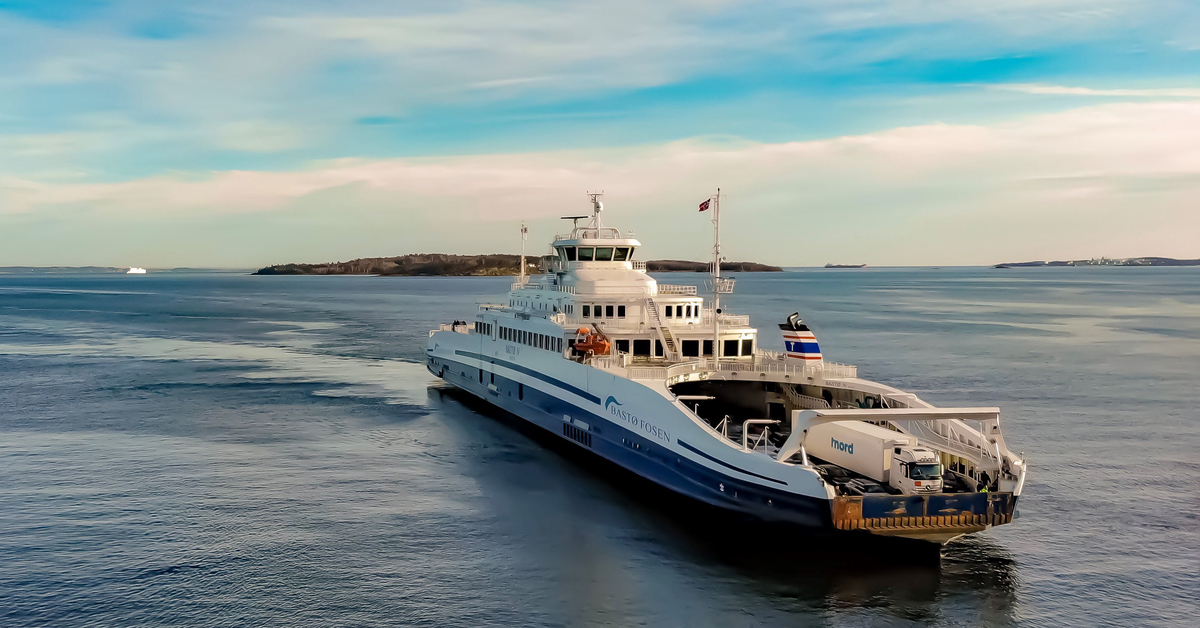
The Bastø Electric, which entered service on Norway’s Moss-Horten ferry route in March 2021, has completed five years of continuous operation as a fully electric vessel. Originally the world’s largest all-electric ferry at 139.2 meters long with a 4.3-MWh battery capacity, it was designed not as a demonstration vessel but as a working ferry capable of handling the same passenger and vehicle loads as traditional diesel ferries, operating across the roughly 10-kilometer crossing in approximately half an hour.
The Moss-Horten connection represents one of Norway’s busiest ferry routes, with current annual traffic figures showing approximately 4 million passengers and 2 million vehicles across roughly 36,000 departures. The route’s short distance and predictable operating pattern made it well-suited for battery propulsion, as the vessel requires sufficient energy only for the crossing plus reserve capacity to reach the next charging cycle. The ferry draws up to 9 MW from shore-based charging infrastructure during docking periods.
The electrification effort extended beyond Bastø Electric itself. Bastø Fosen converted two existing diesel vessels, Bastø IV and Bastø VI, to electric propulsion. When all three operate electrically, they handle approximately 75 percent of the route’s departures and reduce diesel consumption by an estimated 6 million liters annually, down from the route’s previous consumption of roughly 8.5 million liters per year. This equates to approximately 16,000 metric tons of annual CO2 reductions, though actual figures depend on operational practices and electricity usage.
The transition progressed in phases, with initial hybrid operations beginning in 2021 before full electric capability became available at both terminals by 2023. The infrastructure development, while less visible than the vessel itself, proved equally critical to the program’s success. Additionally, Bastø Electric features automation systems from Kongsberg Maritime, including Auto Docking for terminal approaches and Auto Crossing for route optimization, reducing certain operational procedures to basic computer commands while maintaining crew oversight.
The electrification model employed on the Moss-Horten route—combining new construction, vessel conversion, and infrastructure development—reflects an approach likely to be replicated on other ferry services where operators maintain existing fleets and established terminals alongside new electric vessels.
Article Attribution | Read More at Article Source
Article summary produced by Claude AI