

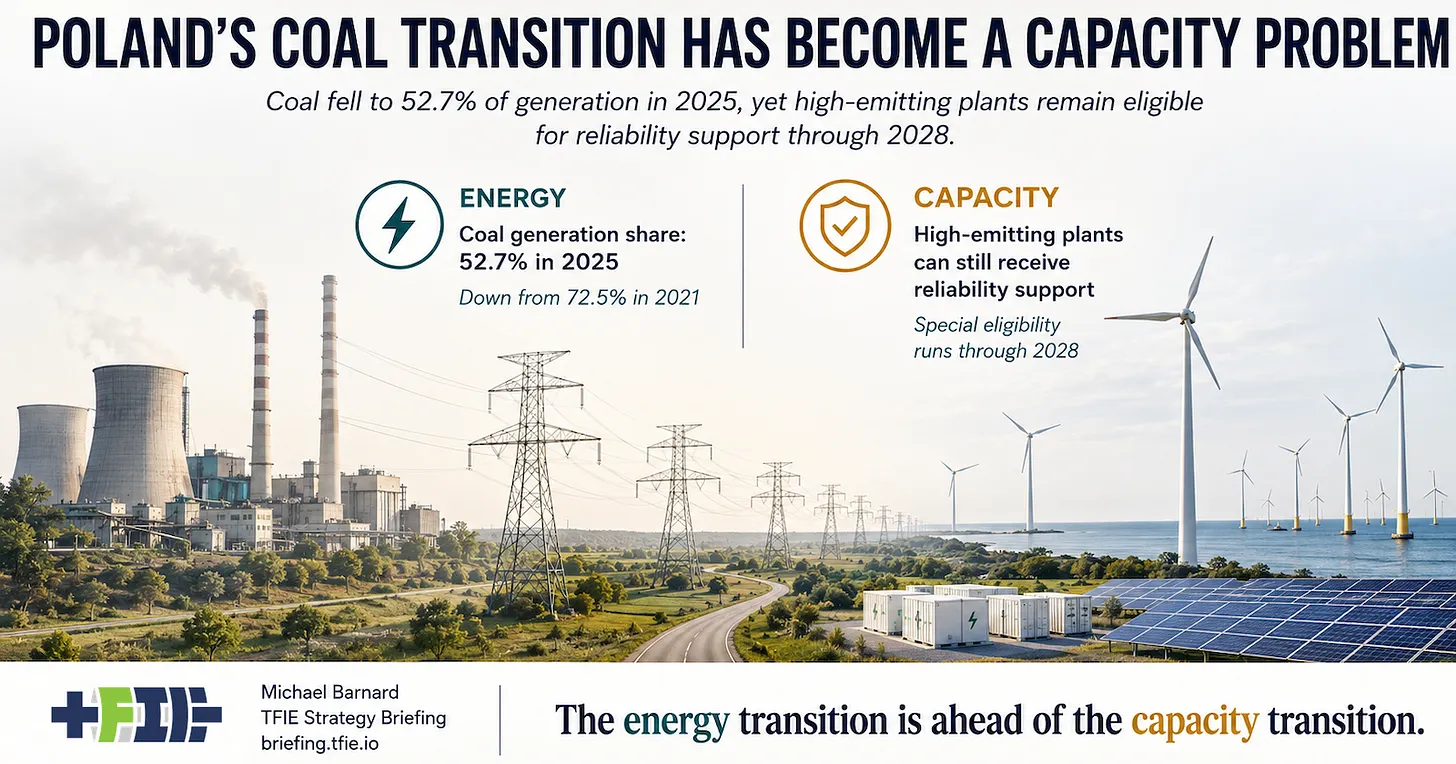
Poland’s electricity generation mix has undergone significant shifts in recent years, with coal’s dominance declining substantially while renewable energy sources have expanded. Coal supplied approximately three-quarters of Poland’s electricity five years ago, but by 2025 this share had contracted to just over half, with renewable sources accounting for nearly a third of generation. Notably, renewable generation exceeded coal production during an entire month for the first time in June of this year.
The transition away from coal has been accompanied by growth in natural gas generation rather than a direct one-to-one replacement with renewables. Gas recorded the largest increase in generation share in both 2024 and 2025, with Poland producing 24.4 TWh from gas compared to 23.8 TWh from onshore wind and 20.3 TWh from solar in 2025. This mixed replacement strategy means Poland is reducing emissions, but through a combination of renewable and fossil fuel sources rather than purely clean energy.
A fundamental tension has emerged between Poland’s rapid progress in reducing coal as an energy source and the continued need for coal capacity to ensure system reliability during peak demand periods or when wind and solar generation is limited. Poland’s capacity market has made this distinction particularly visible, with recent auctions contracting significant generation obligations and permitting high-emission coal plants to participate through 2028 under a European exemption. Renewable growth has become so substantial that Poland curtailed 1.4 TWh of generation in 2025 for balancing purposes, roughly double the previous year’s amount.
The broader transition infrastructure is expanding, with Poland’s first offshore wind farm, Baltic Power, beginning operations in July 2026. Analysts project renewable generation will grow approximately 13% annually through 2030, with renewables expected to overtake coal on an annual basis by 2028 and reach about 53% of total generation by the end of the decade. This transformation requires not only continued renewable buildout but also substantial investments in transmission infrastructure, energy storage, flexible demand systems, and enhanced interconnections to fully displace coal from Poland’s power system.
Article Attribution | Read More at Article Source
Article summary produced by Claude AI