

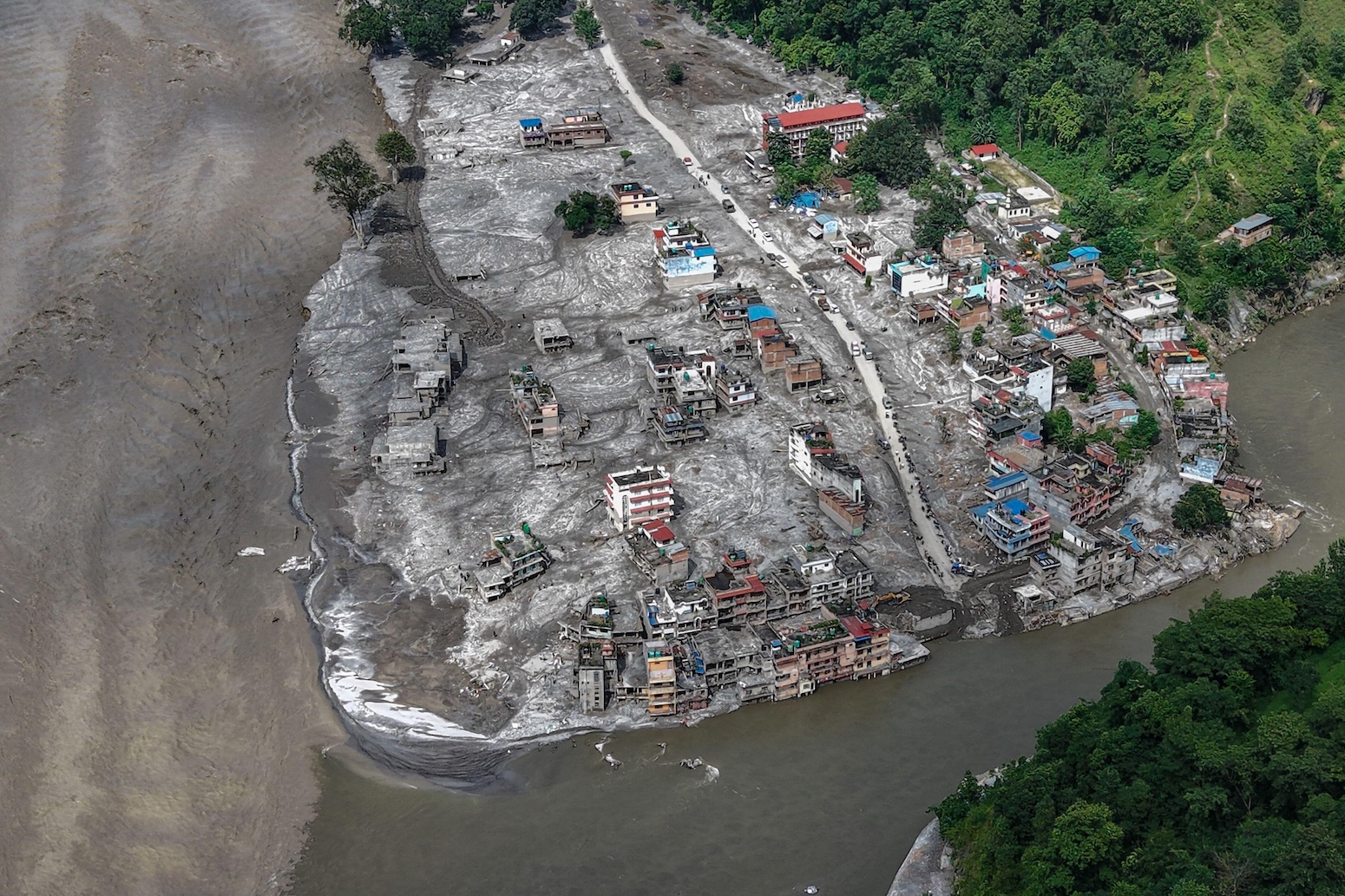
A catastrophic flooding event occurred in the Himalayan border region of Nepal and the Chinese region of Tibet on 26 August, claiming more than 1,300 lives with thousands remaining unaccounted for. Investigations using satellite imagery, drone footage and seismic data revealed that the disaster was initiated by the collapse of bedrock beneath a glacier on Langtang-Lirung mountain, with approximately 5,200 metres of rock and ice breaking loose and descending to the valley floor at 3,000 metres. The initial tremor registered at magnitude 4.4 before the US Geological Survey clarified that the shaking corresponded to a magnitude 5.2 event caused by glacier collapse and debris flow.
The cascading effects were described as a “multi-hazard cascade” by scientific researchers. When the falling ice and debris struck the Lhende Khola river, it formed a large debris lake that subsequently burst and released a powerful floodwave traveling downstream at approximately 30 kilometres per hour. The wall of water and sediment reached the Nepalese town of Mugling, located more than 130 kilometres away, by around 1pm local time, destroying settlements, infrastructure, hydropower plants and border posts across both regions. A second barrier lake formed in Tibet and burst on 28 August, causing additional flooding. Economic assessments indicated that property and infrastructure losses totaled at least $2.5 billion.
Regarding climate change’s potential role, scientists have noted that while no formal attribution study has been completed, warming temperatures are making ice-rock avalanches in the region increasingly likely. A rapid analysis by the World Weather Attribution service published on 17 September identified permafrost thaw and glacial thinning as key contributing factors to the disaster. Researchers highlighted how rapid warming is reshaping Asia’s high-mountain environment. However, some have cautioned against overstating current scientific certainty, noting that the immediate mechanical trigger was bedrock failure whose root causes require further investigation. Nepal’s prime minister characterized the floods as a “serious signal” of escalating risks in the Himalayan region related to climate change.
Article Attribution | Read More at Article Source
Article summary produced by Claude AI