

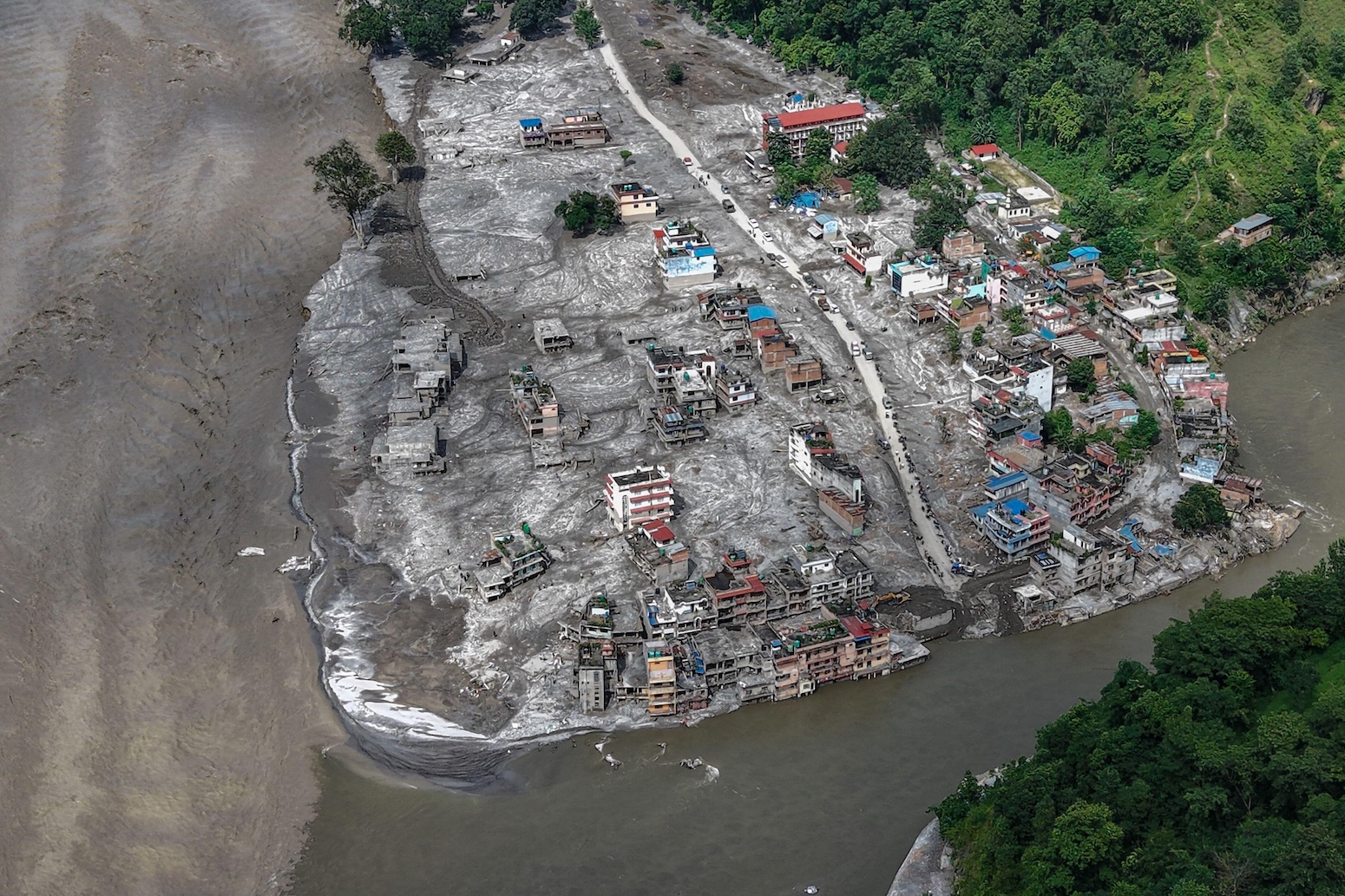
A catastrophic flooding event occurred in the Himalayan border region of Nepal and Tibet on 26 August, resulting in more than 1,300 deaths and thousands of missing persons. Scientists examining satellite imagery, drone footage and seismic data determined that the disaster resulted from a complex sequence of events rather than a single cause.
The HiRisk scientific consortium reported that a mass of bedrock and overlying glacier ice detached from Langtang-Lirung mountain at approximately 5,200 meters elevation, descending to the valley floor at 3,000 meters. The initial seismic tremor, first measured as a magnitude 4.4 earthquake, was later clarified by the US Geological Survey as resulting from glacier collapse and debris flow, equivalent to magnitude 5.2. The falling rock and ice impacted the Lhende Khola river, creating a temporary debris lake. When this lake burst, a wall of water and sediment traveled downstream at approximately 30 kilometers per hour, reaching Mugling—a town over 130 kilometers away—by early afternoon. The floodwaters caused a subsequent barrier lake to form in Tibet, which burst two days later, triggering additional flooding downstream. Property and infrastructure damage was estimated at a minimum of $2.5 billion.
Initial reports attributed the trigger to a collapsing glacier, but further analysis revealed that bedrock beneath the glacier had failed catastrophically, with the glacier subsequently being carried downslope. Scientists note that such bedrock failures are becoming increasingly common in mountain regions following rapid glacier melting. Geoscientists indicate the rock collapse likely resulted from mechanical stress accumulated over extended periods.
While some have suggested climate change played no role based on the bedrock failure mechanism, researchers have emphasized that rising temperatures, glacier retreat and permafrost thaw may have all contributed to destabilizing conditions. Nepal’s prime minister characterized the floods as a warning signal regarding increasing risks in the Himalayan region linked to climate change. However, no formal attribution study has been completed to quantify climate change’s specific contribution to this particular event.
Article Attribution | Read More at Article Source
Article summary produced by Claude AI