

The United States has access to an estimated 1,170 terawatt-hours per year of potential wave energy generation across its coastal regions, including Puerto Rico, Alaska, and Hawaii. Wave energy represents a form of marine energy that harnesses the kinetic power of ocean waves, tides, and currents to produce electricity continuously. Despite shifts in federal energy policy priorities, the Trump administration has maintained support for marine energy as a branch of hydropower development, signaling backing through an expanded energy collaboration with Norway announced in July 2025.
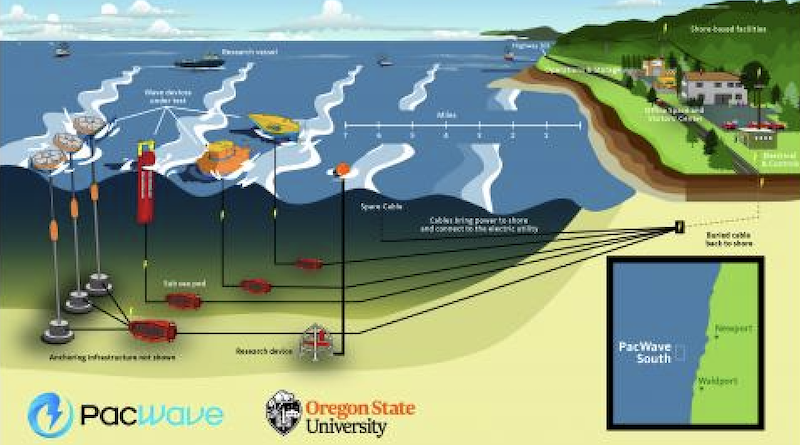
A major milestone occurred earlier this week when the Energy Department announced the official opening of PacWave South, a grid-connected wave energy testing facility located seven miles off the Oregon coast. The facility represents the culmination of over a dozen years of planning and construction efforts developed in partnership with Oregon State University. Its pre-permitted status allows wave energy developers to test new devices without incurring regulatory delays that typically add significant time and expense to the development process. The Bonneville Power Administration previously signed an agreement to purchase power generated by devices tested at the facility.
Beyond PacWave South, other research initiatives are advancing the field’s technical capabilities. The National Laboratory of the Rockers, in collaboration with the University of Hawaii, recently completed a five-month data collection effort using its SURF-WEC wave energy converter prototype. The device, comparable in size to a large television screen, oscillates with wave motion to drive a hydraulic system that generates electricity. Researchers emphasize that providing open access to design specifications, operational data, and implementation insights will help address the industry’s historical shortage of real-world performance information.
The Energy Department continues supporting marine energy research through its TEAMER organization, which funds work at a network of research centers throughout the United States, including coastal facilities and inland test laboratories. Industry observers note that despite slow commercial progress historically, recent years have witnessed increased global activity in marine energy development. Advocates suggest the sector could follow a similar trajectory to wind and solar industries, which expanded substantially since the early 2000s.
Article Attribution | Read More at Article Source
Article summary produced by Claude AI