

The United States possesses substantial untapped wave energy resources with the potential to generate approximately 1,170 terawatt-hours annually across its coastlines, including Alaska, Hawaii, and Puerto Rico. Despite these resources, wave energy development has progressed slower than other renewable sectors. Marine energy, which harnesses kinetic energy from waves, tides, and currents, operates continuously throughout the day and could contribute meaningfully to decarbonization efforts.
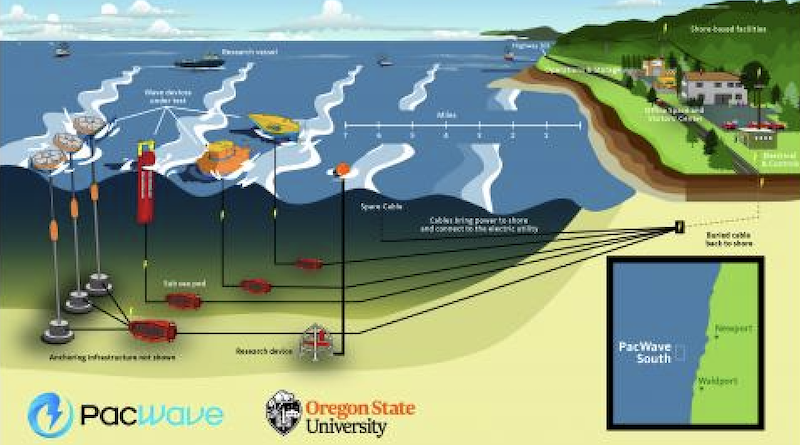
Recent federal support has bolstered the sector’s prospects. The Trump administration expanded an Energy Department collaboration with Norway to encompass marine energy in July 2025. The Energy Department’s TEAMER organization continues backing research and development across a network of US marine energy centers, including coastal facilities and inland test facilities. A significant milestone occurred earlier this week when the Energy Department announced the official opening of PacWave South, a grid-connected wave energy test facility located seven miles off the Oregon coast. The facility, developed through a partnership with Oregon State University, has been in planning and construction for over a dozen years.
PacWave South is designed to accelerate commercial deployment by eliminating permitting delays that typically add costs and extend testing timelines. The facility holds pre-permit status and a lease agreement issued in 2021 from the Bureau of Ocean Energy Management. It can accommodate up to 20 wave converters across four berths and features purpose-built mooring systems designed to reduce costs across different device types. The Bonneville Power Administration signed an agreement last year to purchase power generated at the facility.
Parallel developments are advancing wave energy technology elsewhere. The National Laboratory of the Rockers recently concluded a five-month data collection effort in Hawaii, collaborating with the University of Hawaii on a small-scale wave energy converter called SURF-WEC. The device operates by oscillating with wave motion to drive a hydraulic system that generates electricity. These initiatives address a critical industry challenge: the scarcity of real-world operational data needed to accelerate innovation and cost reduction across the sector.
Article Attribution | Read More at Article Source
Article summary produced by Claude AI