

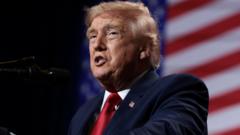
President Trump made comments during a two-day visit to Ireland expressing support for a unified Ireland, generating significant international attention. The remarks came first during a press conference and were reiterated shortly thereafter during a speech at the US Ambassador’s residence, where Trump addressed Irish and Irish-American business leaders.
Former Republican Congressman Mick Mulvaney, who served as Trump’s special envoy to Northern Ireland during his previous administration, cautioned against interpreting the statements as a policy change. Both Mulvaney and Democratic Congressman Brendan Boyle emphasized continued bipartisan commitment to the Good Friday Agreement, noting that while Trump may be correct in suggesting unification could occur eventually, this does not indicate the US intends to actively promote such an outcome.
The context surrounding the remarks raised questions about their intended audience. Though ostensibly directed at business leaders gathered in Dublin, Trump’s speech strayed significantly from its advertised 20-minute format, extending roughly twice that length and covering numerous domestic US policy matters including immigration, defense production, and military operations. Trump has described his speaking style as “the weave,” characterized by frequent topic shifts and departures from prepared remarks.
Analysts suggested the comments may have been strategically targeted at Irish-American voters in the United States rather than the immediate Dublin audience. With midterm elections approaching in November, the Republican party faces pressure regarding presidential policies and risks losing control of one or both houses of Congress. Approximately one-tenth of the US population claims Irish heritage, and Irish-American voters represent a demographically significant swing constituency that has shifted between parties in recent election cycles.
Historically, Democratic candidates have secured Irish-American support through engagement on Irish issues, notably Bill Clinton’s involvement with the peace process that contributed to the Good Friday Agreement’s foundation. However, observers noted that Irish-American political attitudes and broader American polarization have shifted substantially since that period.
Article Attribution | Read More at Article Source
Article summary produced by Claude AI