

The UK Civil Aviation Authority has launched its latest Hydrogen Challenge initiative to examine hydrogen-aircraft operations at London City Airport, focusing on cryogenic hydrogen storage, airside supply systems, and broader aviation roadmap objectives targeting small aircraft scaled operations by 2035. Major manufacturers including Airbus, MTU, and ZeroAvia are making progress on hydrogen fuel-cell engines and electric propulsion systems, with ZeroAvia achieving notable Federal Aviation Administration certification milestones with its electric engine.
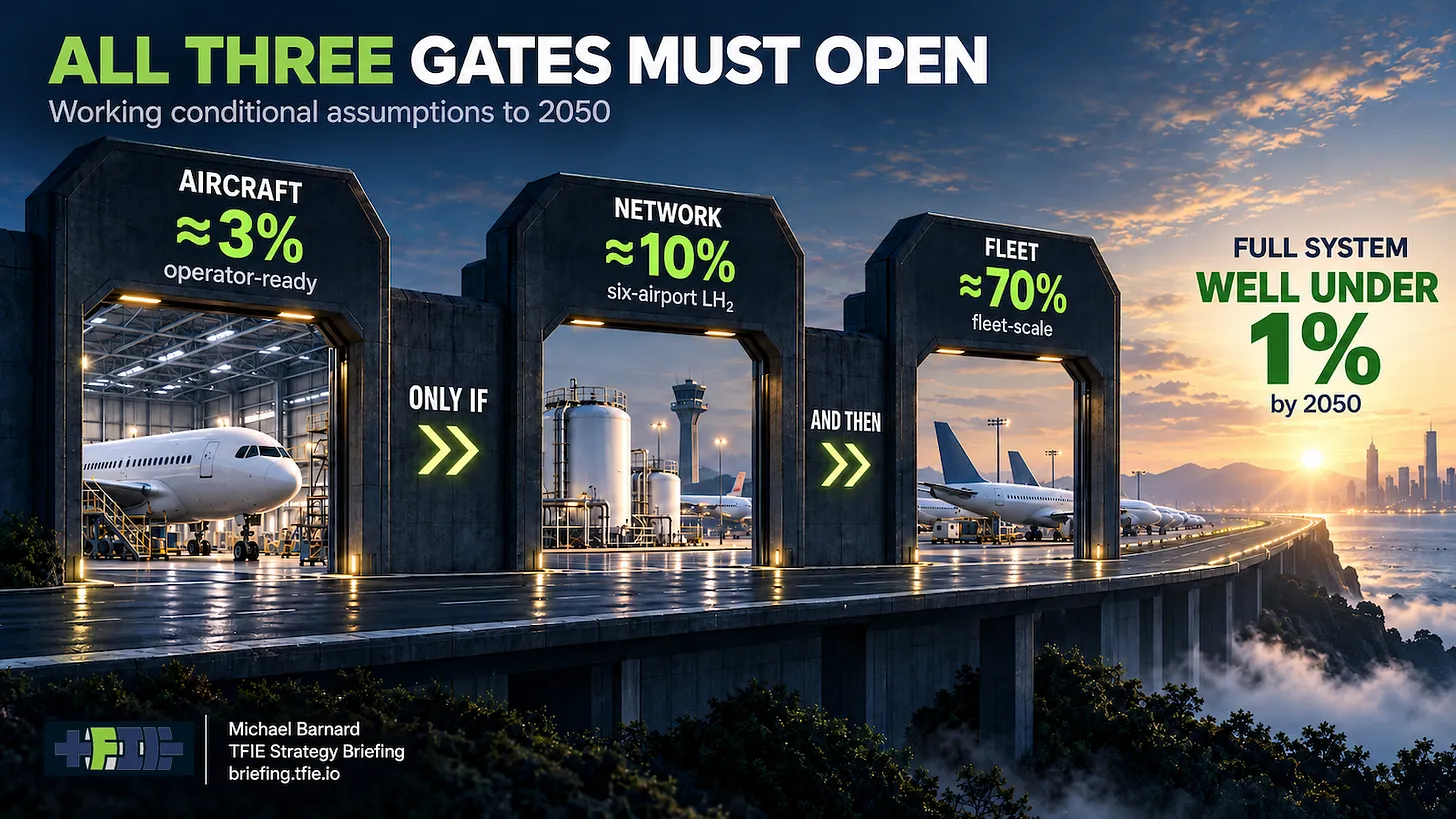
A comprehensive assessment of hydrogen passenger aviation examined a standard commercial mission involving a 150-passenger aircraft traveling 2,500 kilometers while accounting for required fuel tanks, insulation systems, safety mechanisms, and certification standards. Even with optimistic assumptions granting individual components success probabilities between 60% and 85%, the analysis found that a fully operational, manufacturer-ready aircraft through conventional design routes reaches approximately 3% likelihood by 2050. When incorporating airport network requirements and fleet-scale operations, the probability for a complete medium-haul passenger system drops well below 1%.
Airport infrastructure presents a secondary set of critical dependencies beyond aircraft development. Moving beyond conceptual hydrogen infrastructure references, current studies address specific requirements including pipelines, liquefaction facilities, cryogenic storage, electricity supply, delivery logistics, and system reliability buffers. These airport-level systems must mature simultaneously with aircraft production and fleet operations, creating interdependent development timelines that significantly complicate the overall pathway.
Hydrogen’s competitive position within aviation markets also presents challenges. At the 2,500-kilometer range examined, hydrogen must compete primarily against conventional liquid-fuel turbine aircraft and sustainable aviation fuels rather than battery-electric alternatives. Hydrogen propulsion requires replacing substantially more of existing aviation infrastructure and operations compared to alternative fuel pathways. While regulatory frameworks are developing and manufacturers continue engineering progress, the integration of commercially viable aircraft, production systems, and fuel networks remains the binding constraint on hydrogen passenger aviation viability by 2050.
Article Attribution | Read More at Article Source
Article summary produced by Claude AI