

The UK Civil Aviation Authority has launched a new Hydrogen Challenge examining hydrogen-aircraft operations at London City Airport, including cryogenic hydrogen storage, airside supply systems, and a broader aviation roadmap targeting small aircraft operations by 2035. Major manufacturers including Airbus, MTU, and ZeroAvia are developing hydrogen fuel-cell and electric propulsion systems, with regulatory frameworks beginning to take shape around certification requirements.
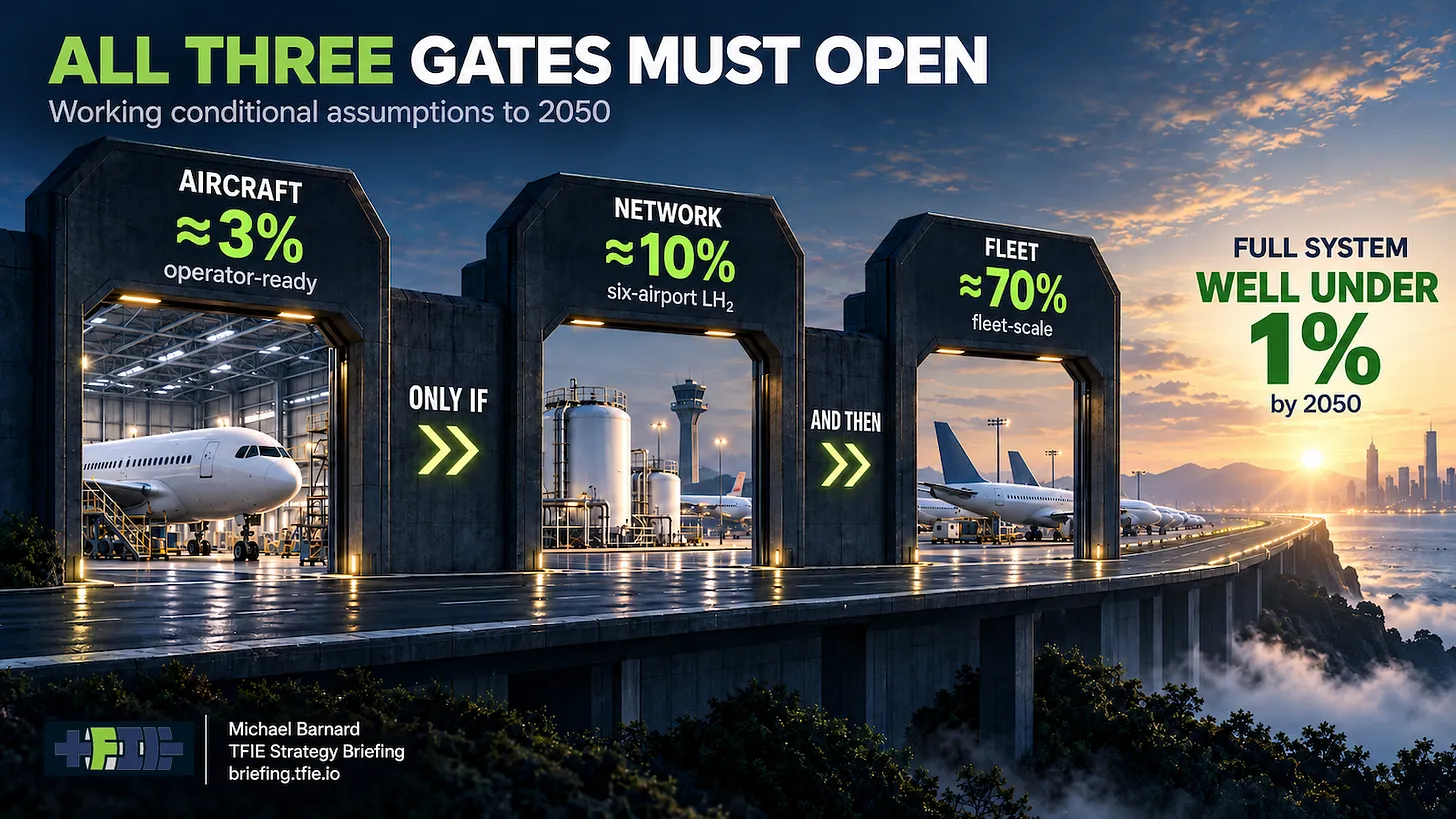
Despite this engineering progress, a recent comprehensive assessment of hydrogen passenger aviation indicates fundamental commercial barriers remain. The analysis modeled a conventional 150-passenger aircraft on a 2,500-kilometer route and traced the cascading requirements for tank design, insulation, safety systems, large-aircraft certification, repeatable production, and airport fuel infrastructure. Even with favorable assumptions applied to individual technical steps, the least-implausible conventional design pathway achieves only approximately 3% probability of becoming operator-ready by 2050.
Airport infrastructure presents a second layer of dependencies requiring simultaneous maturation. Current studies are moving beyond theoretical discussions of hydrogen infrastructure toward specific engineering challenges including pipelines, liquefaction facilities, cryogenic storage, electricity supply, delivery logistics, and operational redundancy. The development of viable aircraft, fuel production and distribution networks, and commercial-scale fleets must occur in parallel rather than sequentially, creating interdependent technical and economic challenges.
When aircraft development, airport infrastructure, and fleet-scale requirements are combined as an integrated system, the probability for a complete clean-sheet hydrogen passenger system reaches well below 1% by 2050 under current assumptions. Fuel cost, while economically relevant, does not address the underlying technical constraints related to tank volume, crashworthiness standards, certification requirements, airport throughput capacity, or manufacturing scalability. At the 2,500-kilometer range, hydrogen aviation competes primarily against conventional liquid-fuel turbine aircraft and sustainable aviation fuels rather than battery-electric alternatives, requiring replacement of substantially more existing aviation infrastructure to achieve comparable performance.
Article Attribution | Read More at Article Source
Article summary produced by Claude AI