

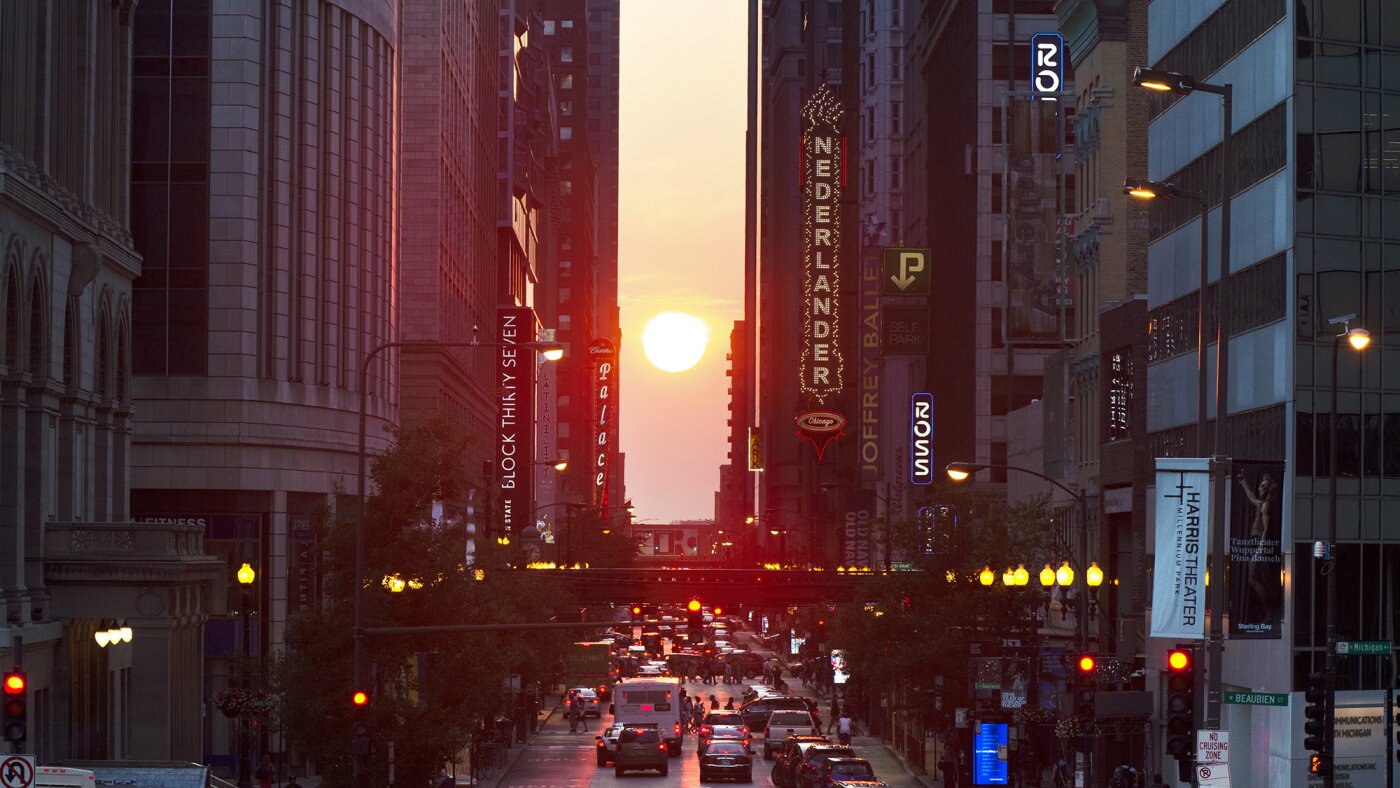
The arrival of the fall equinox on September 22 in the U.S. brings not only shorter days and the seasonal shift but also a striking celestial-urban phenomenon in grid-designed cities. In locations such as Chicago, Washington, D.C., and Phoenix, the sun aligns with streets running east and west, creating dramatic visual effects where the rising or setting sun frames tall buildings and stretches of asphalt. Residents and tourists call these occurrences by various names, with Chicago’s version earning the moniker “Chicagohenge” after England’s famously solar-aligned Stonehenge.
Geoff Boeing, chair of the Department of Urban Planning and Spatial Analysis at the University of Southern California, notes that these alignments reflect how human-built environments frame our understanding of the universe. The phenomenon occurs due to city street designs that follow cardinal compass directions—north, east, west, and south—combined with the width of thoroughfares and the height of surrounding structures. Michelle Nichols, senior director of public programs at the Adler Planetarium in Chicago, explains that the downtown canyon of tall buildings accentuates the effect, making it particularly dramatic in urban cores.
The practice of aligning cities with celestial and geographic points traces back millennia. Boeing notes that early cities, particularly thousands of years ago, were often developed with what he calls “cosmic urban plans,” designed as cosmological maps where specific urban locations corresponded to stars and celestial events. Ancient examples include Tenochtitlan, the Aztec precursor to Mexico City, which was carefully planned with astronomical knowledge. In modern times, these alignments typically result from practical 19th-century urban planning decisions rather than intentional cosmic design. Grid layouts made it easier to buy and sell land and to map infrastructure like railroads, particularly during westward expansion across the Midwest and Great Plains.
While social media and photo-sharing platforms have popularized equinox viewing in recent years, safety concerns accompany the trend. Nichols cautions observers to avoid stepping into streets to capture perfect photographs and reminds drivers that east-west street driving during equinox times can involve dangerous glare from the sun. She also notes that the phenomenon can contribute to traffic buildups as drivers contend with reduced visibility from direct sunlight in their line of sight.
Article Attribution | Read More at Article Source
Article summary produced by Claude AI