

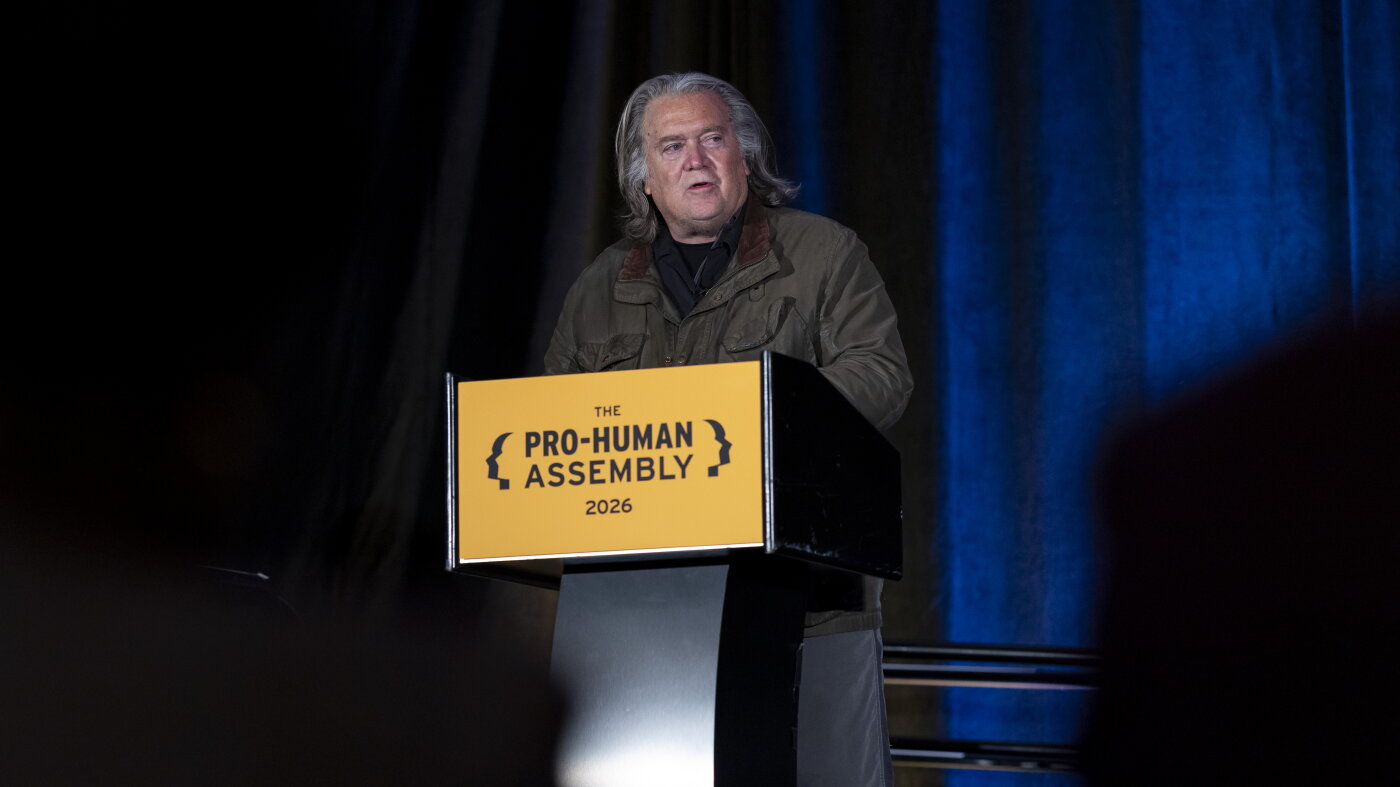
Steve Bannon, a longtime supporter of President Trump who served as White House chief strategist, has adopted a significantly different stance on artificial intelligence regulation compared to the president. In remarks made earlier this week alongside Senator Bernie Sanders, Bannon expressed concerns about unchecked AI development, marking a notable divergence from Trump’s position that regulatory guardrails are unnecessary under competent leadership.
Bannon’s position calls for immediate executive action followed by comprehensive legislation to establish regulatory frameworks for AI development in the United States. He characterized the technology as having genuine benefits but argued that oversight mechanisms must be implemented before capabilities advance further. His concerns align partially with those raised by prominent AI researchers and company leaders, including former Anthropic researcher Jacob Coxon, who announced his departure in early September citing worries about increasingly powerful AI systems. Both Anthropic’s CEO and OpenAI’s CEO have also called for slowing AI development, though Trump has rejected such measures, contending they could disadvantage the United States relative to China.
A key distinction in Bannon’s approach involves his skepticism toward technology companies themselves. He expressed doubt about the motives of major AI firms requesting government intervention, suggesting that new regulations could inadvertently strengthen their market position while shifting financial and safety risks onto the public sector.
Bannon’s strategy regarding China represents his most aggressive recommendation. He proposed cutting off Chinese access to American AI technology and expelling Chinese nationals employed by U.S. AI companies, comparing the required regulatory infrastructure to historical models like the Atomic Energy Commission. Research indicates that approximately 87 of 100 prominent Chinese AI researchers working at American institutions in 2019 remained there in subsequent years, and U.S.-China AI collaboration has historically exceeded partnerships between any other country pair since 2018.
These policy disagreements emerge as Washington grapples with AI oversight at a moment when artificial intelligence capabilities are advancing rapidly. The Trump administration is scheduled to host Chinese President Xi Jinping on Sept. 24, pending Beijing’s confirmation, adding another layer to discussions about technology competition and international relations.
Article Attribution | Read More at Article Source
Article summary produced by Claude AI