

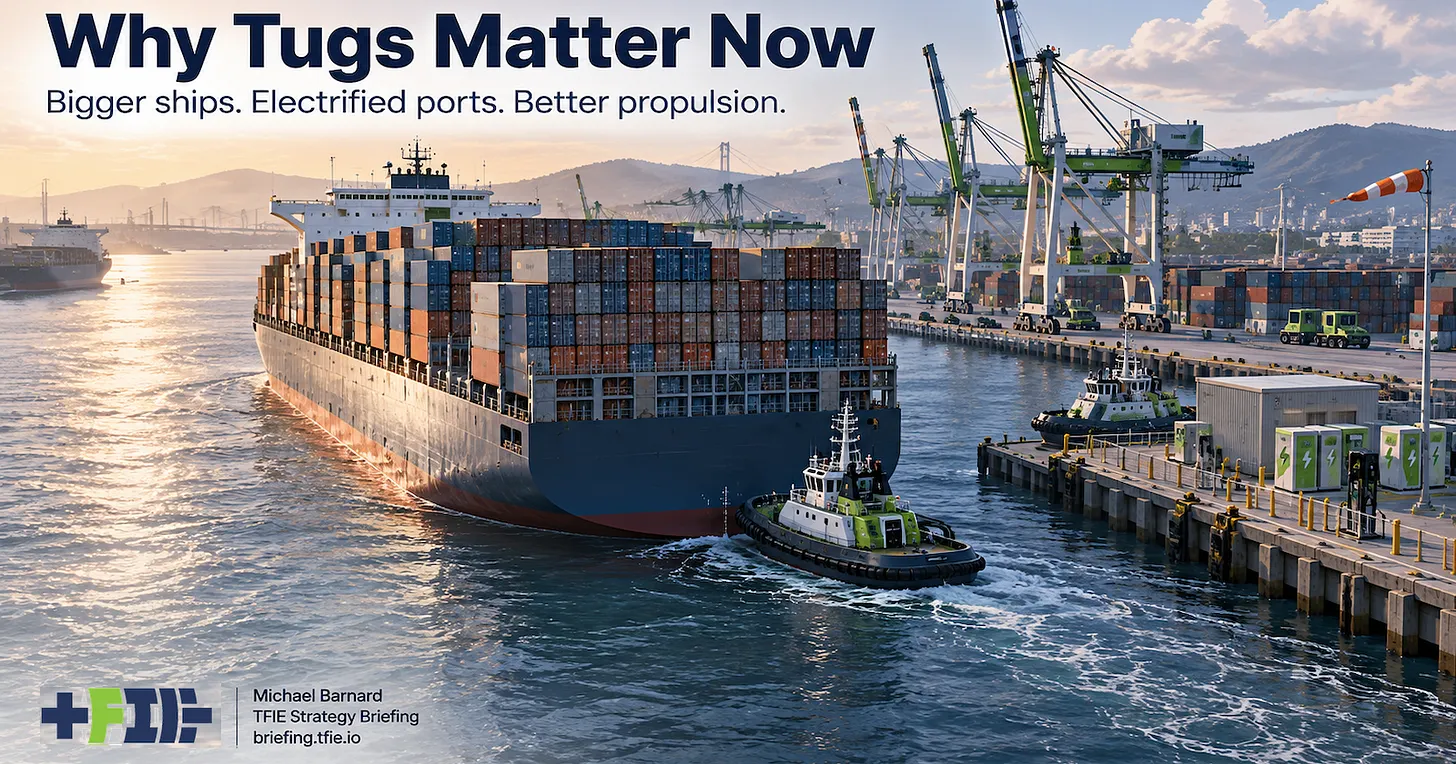
Tugboats are emerging as unexpected candidates for battery electric propulsion, challenging conventional assumptions about their energy requirements. While these vessels are rated for multiple megawatts of power to handle maximum bollard pull—the static force needed to move massive ships—their actual operational duty cycle differs significantly from sustained high-load work. Tugboat operations consist largely of waiting periods, low-speed transit, and positioning maneuvers punctuated by short bursts of maximum thrust, a pattern that aligns well with battery capabilities.
Battery and electric motor systems offer distinct advantages for this operational profile. Batteries excel at delivering large amounts of power over short durations, while electric motors maintain efficiency across broad operating ranges and adjust torque rapidly through power electronics. This combination reduces the penalty of sizing equipment for peak performance, unlike combustion engines that operate inefficiently during low-load periods. As battery costs decline and charging infrastructure improves, the proportion of work that can be powered electrically rather than by combustion increases.
Design innovations further reduce battery requirements by minimizing wasted energy. The TRAnsverse propulsion system, developed by Svitzer and Robert Allan, uses separated steerable units that reduce repositioning time and energy. By lowering overall energy demands before selecting a power source, operators can rely on smaller batteries than maximum power ratings might suggest.
Geographic factors also favor tugboat electrification. Harbor operations concentrate in limited areas with growing electrical infrastructure—including shore power, electric cranes, and charging systems—making port-based charging feasible. Vancouver currently operates two battery-electric ElectRA tugs, providing real-world performance data that demonstrates the gap between theoretical requirements and actual needs.
While only dozens of battery-first harbor tugs operate globally compared to roughly 23,500 seagoing tugs overall, the order pipeline suggests momentum. Svitzer has four battery-electric TRAnsverse tugs under construction, and Curtin Maritime has ordered eight large-battery hybrid-electric vessels. The transition reflects evolving operator procurement decisions rather than wholesale fleet replacement, as existing diesel vessels remain serviceable for decades.
Article Attribution | Read More at Article Source
Article summary produced by Claude AI