

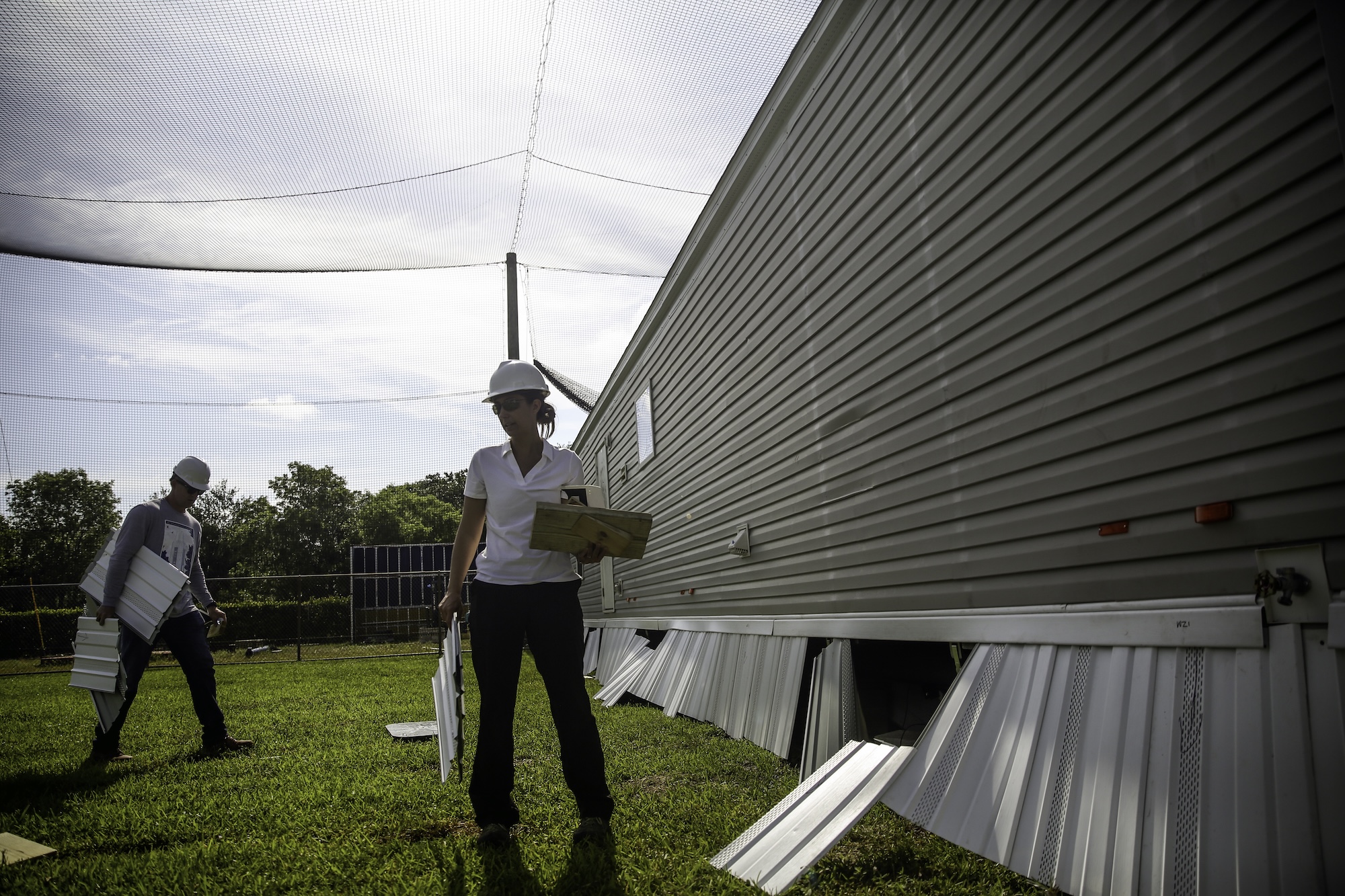
Engineers at Florida International University’s Wall of Wind facility are conducting systematic tests on manufactured homes to understand how construction and installation standards affect their ability to withstand extreme weather events. The laboratory uses 12 massive fans capable of generating winds up to 157 mph, accompanied by rain, to stress-test structures until they fail. Researchers document where failures occur and evaluate whether modifications to installation or design could improve resilience.
Manufactured homes, which account for housing for more than 20 million Americans across approximately 6.7 million structures, face disproportionate exposure to hurricanes, tornadoes, and other extreme wind events. These homes are typically installed on above-ground piers rather than traditional foundations, making their wind resistance dependent on support systems, straps, and anchors in addition to structural integrity. Unlike site-built houses regulated by local building codes, manufactured homes fall under a single federal construction and safety code administered by the Department of Housing and Urban Development.
Structural engineer Elaina Sutley of the University of Kansas leads the research effort, motivated by personal experience with natural disasters. She was present during a devastating tornado outbreak in Tuscaloosa, Alabama, approximately 15 years ago that caused extensive casualties and billions in property damage. Her research focuses on protecting vulnerable populations through improved building standards and climate hazard resilience.
The current federal regulatory framework divides the country into three wind zones with varying standards. Most of the United States falls within Wind Zone 1, where manufactured homes must withstand winds of 70 mph, while more stringent requirements apply to hurricane-prone coastal areas designated as Zones 2 and 3. Sutley’s experiments test whether applying stricter standards nationwide would improve safety. The testing varies multiple conditions including installation methods, wind speeds, wind direction, elevation, support systems, and openings that allow wind penetration, with each configuration tested until structural failure occurs.
Article Attribution | Read More at Article Source
Article summary produced by Claude AI