

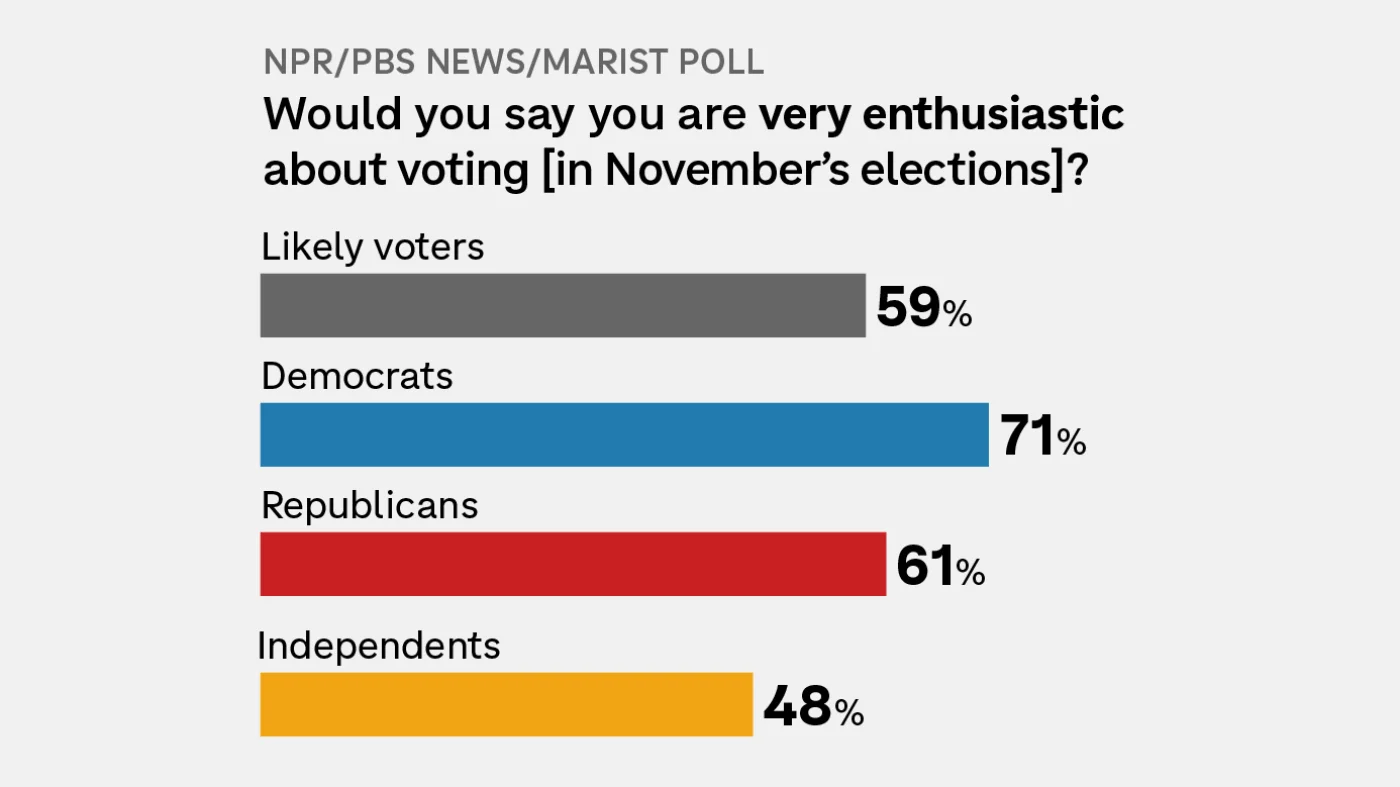
Democrats maintain significant advantages heading into midterm elections, with polling data suggesting they are positioned to win control of the U.S. House, according to a survey conducted by NPR, PBS News, and Marist. However, the same data reveals factors that could constrain the magnitude of any Democratic wave, researchers found.
The poll, conducted October 19-20 among 1,289 registered voters, found that 38% of registered voters approved of President Trump’s job performance, with 61% disapproving. Among likely voters, Trump’s approval stood at 40% with 59% disapproving—a smaller gap but still a negative rating. On the generic congressional ballot, Democrats held a 10-point advantage among registered voters and an 8-point advantage among likely voters, margins that historically have correlated with significant House seat gains.
Economic concerns dominated voter priorities, with approximately one-third of respondents reporting financial hardship in the past year and four in ten saying their personal finances worsened. Cost of living emerged as voters’ top concern across the political spectrum. Beyond economic issues, preserving democracy resonated with Democrats and independents, while immigration represented the leading concern among self-described MAGA supporters.
Despite Democratic advantages, structural factors present obstacles. Recent redistricting following the 2020 Census, along with mid-decade redistricting in Republican-controlled states, has tilted congressional seats in Republicans’ favor nationally. Additionally, 81% of Democratic likely voters said they believed the Democratic candidate in their district would win, compared to 98% who said they would vote Democratic—a 17-point gap that researchers noted reflected notable nervousness among party members.
Voters showed mixed motivations, with 55% of likely voters saying it was more important to support candidates offering new ideas and change rather than incumbents. Notably, 44% of likely voters said their vote would be cast against Trump, compared to 21% voting for him, despite Trump not appearing on the ballot himself. The poll carried a margin of error of plus or minus 3.7 percentage points for registered voters and plus or minus 3.8 points for likely voters.
Article Attribution | Read More at Article Source
Article summary produced by Claude AI