

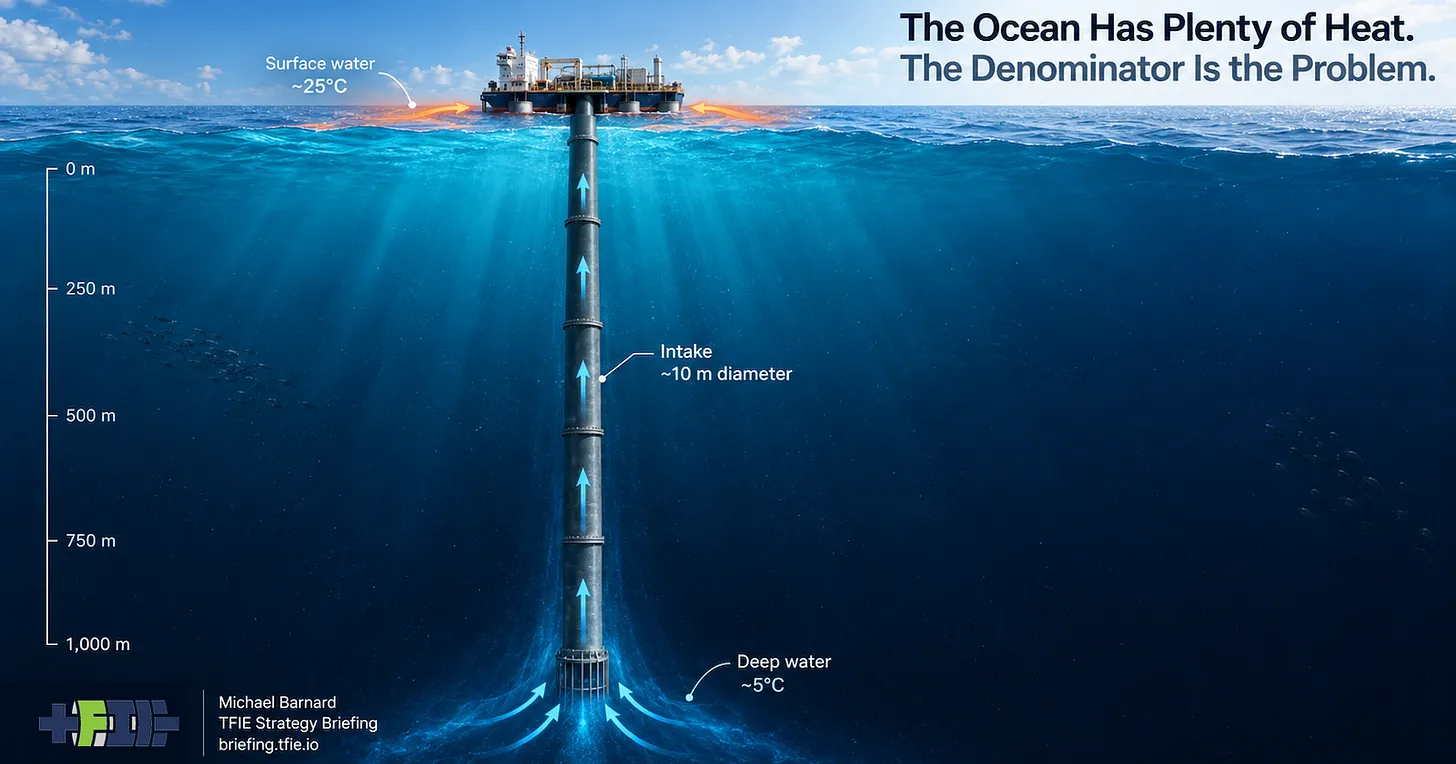
Ocean thermal energy conversion leverages the temperature difference between warm tropical surface water and cold deep seawater to generate electricity through a heat engine cycle. The approach relies on established thermodynamic principles and has produced net electricity in operational demonstrations, primarily in Hawaii, with decades of engineering refinement behind the concept.
The fundamental constraint in OTEC technology stems from its inherent low efficiency. A heat engine operating between typical tropical conditions of 25°C surface water and 5°C deep water has a theoretical maximum efficiency of approximately 6.7 percent, with practical implementations achieving only single-digit efficiency levels when accounting for real-world components including heat exchangers, turbines, and pumps. This low efficiency creates substantial infrastructure requirements because generating each megawatt of useful electricity requires processing enormous quantities of thermal energy.
A reference design for a 100 megawatt net output facility requires approximately 235 cubic metres of deep cold water and 470 cubic metres of warm surface water per second, totaling 705,000 liters every second. This massive flow rate necessitates a cold-water intake pipe approximately 10 metres in diameter extending roughly one kilometre in length. The primary engineering challenge involves managing friction, pressure losses, and parasitic loads across this extended pipe network carrying hundreds of tonnes of seawater each second.
Floating offshore OTEC systems can reduce horizontal distances to deep water but introduce different engineering burdens including exposure to currents, storms, corrosion, and stationkeeping demands. The heat exchanger systems themselves require substantial scale to move gigawatts of thermal energy. While offshore engineering can construct structures of this magnitude, the critical question concerns whether such systems can be built cost-effectively and repeatedly to compete with energy technologies manufactured at scale with established supply chains.
Despite successful demonstrations dating to 1979 in Hawaii and subsequent projects in Japan and elsewhere, commercial-scale deployment has not materialized. The technology’s strongest potential applications involve steep tropical islands with nearby deep water, high electricity costs, and land constraints, yet such locations typically have access to alternative energy sources including solar, wind, batteries, and geothermal resources. Widespread commercial OTEC deployment would require successful multi-megawatt operation at an optimal location with transparent performance data and subsequent commercial orders, rather than continued demonstrations of the fundamental thermodynamic principle.
Article Attribution | Read More at Article Source
Article summary produced by Claude AI