

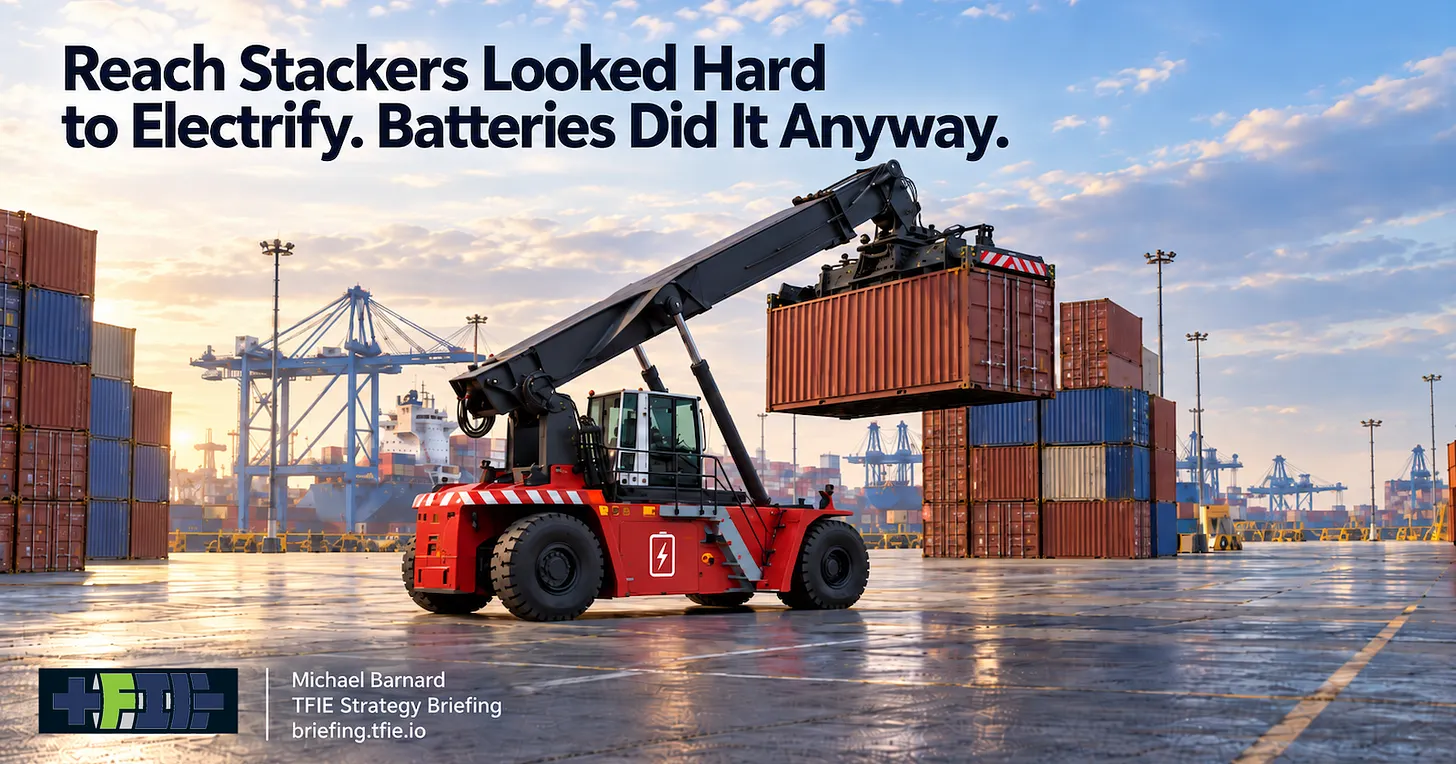
Battery-electric reach stackers are becoming the preferred zero-emission technology at port terminals worldwide, contrary to expectations that hydrogen would dominate this application. Industry analysis suggests roughly 1,500 battery-electric machines currently operate globally, constituting approximately 15% to 16% of the worldwide fleet of approximately 9,300 units, with electric models potentially accounting for close to one-fifth of current production.
The technology’s viability stems from the distinction between a reach stacker’s substantial mass—often exceeding 70 tonnes before handling loaded containers—and its actual energy requirements. Despite their size and lifting capacity, these machines operate over short distances on terminal pavements at relatively low average speeds. Operating data from Reliance Transport in New Zealand indicates their 74-tonne electric reach stacker consumes approximately 33 kilowatt-hours per operating hour while completing full shifts and handling approximately 100 container moves daily. This lower-than-expected energy consumption enables practical charging solutions during existing work breaks or through battery packs supporting full eight-hour shifts.
Economic analysis increasingly favors battery-electric systems over diesel alternatives. Earlier projections estimated battery-electric reach stackers at approximately 15% higher total cost of ownership than diesel equipment, with anticipated price parity within roughly five years. Current commercial data suggests this crossover is occurring ahead of schedule. Reliance Transport reports its electric machine delivers approximately 80% lower energy costs and 65% lower maintenance costs compared to its replaced diesel counterpart. Kalmar’s modeling estimates five-year electric total cost of ownership 16% below diesel under French operating assumptions, though this excludes charging infrastructure costs.
Procurement patterns demonstrate growing operator confidence beyond initial trials. Multiple terminals have progressed from single pilot machines to larger orders, including Westport expanding from one to four additional units and Portonave ordering five machines following its first deployment. APM Terminals projects purchasing or retrofitting approximately 500 electric reach stackers throughout the coming decade. In contrast, hydrogen fuel-cell alternatives remain limited to demonstration phases, with the Port of Valencia’s pilot ending without generating fleet orders.
The technology transition reflects broader port decarbonization requirements driven by climate and air-quality objectives. Battery-electric reach stackers address these mandates while simultaneously reducing operational expenditure, creating economic incentives beyond environmental considerations. The natural alignment of battery capacity with existing work cycles and charging opportunities during operational pauses has proven more practical than initially anticipated for this equipment category.
Article Attribution | Read More at Article Source
Article summary produced by Claude AI