

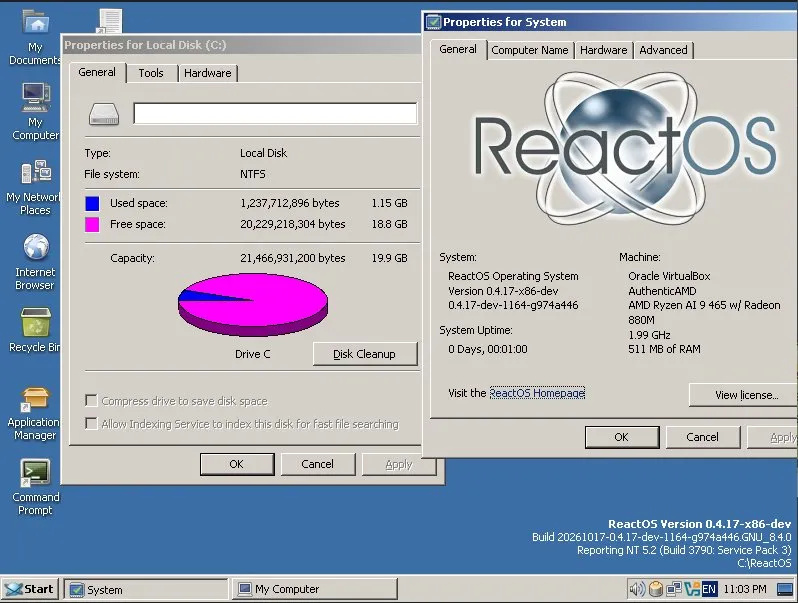
ReactOS, a community-driven open source operating system designed to replicate Windows functionality, has achieved a notable development milestone by enabling direct installation to NTFS partitions. The project previously required users to install on FAT32 partitions, a limitation that hindered its compatibility goals.
NTFS is a proprietary filesystem developed by Microsoft with origins tracing back to the Windows NT family beginning in 1993. The modern variant deployed since 2001 with Windows XP remains the standard filesystem for most Windows systems. Since ReactOS aims for binary compatibility with Windows Server 2003, the inability to install directly onto NTFS represented a significant practical barrier to achieving its compatibility objectives.
The newly implemented NTFS driver represents substantial progress, though it currently operates with notable limitations. The development team acknowledged that the driver lacks caching mechanisms, which results in reduced performance compared to production implementations. Additionally, the driver does not yet support journaling or security features, and the team flagged the possibility of undiscovered bugs requiring further refinement.
The addition represents approximately a decade of incremental development efforts. Read-only NTFS support was integrated into ReactOS in 2016, followed by boot support additions to FreeLoader in 2022. The new driver eliminates the remaining gap that prevented direct OS installation to NTFS volumes. ReactOS is maintained by a volunteer-driven community that coordinates development through public platforms including GitHub and project forums.
The milestone reflects the complexity involved in reimplementing an operating system from scratch, a factor that has kept ReactOS in alpha status throughout its extended development timeline. While the project may not represent a practical Windows replacement for most users, achieving NTFS installation capability demonstrates continued progress toward its long-term objectives.
Article Attribution | Read More at Article Source
Article summary produced by Claude AI