

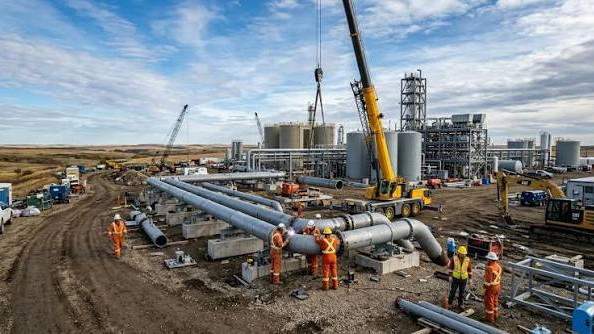
Heidelberg Materials announced plans in 2023 to develop North America’s first full-scale carbon capture installation at a cement plant in Edmonton, with Canadian government backing and a pilot that confirmed technical feasibility. The project was designed to capture over one million tonnes of carbon dioxide annually, with the captured material to be transported via pipeline to the planned Open Access Wabamun Carbon Hub for geological storage. The Canadian government committed substantial support, including up to CAD 275 million in direct funding and access to a refundable investment tax credit covering up to 50% of eligible capture equipment costs.
However, the project has been placed on hold despite passing technical and policy requirements. Initial capital cost estimates of CAD 1.36 billion escalated to approximately CAD 2 billion, while projected revenue from avoided carbon emissions declined significantly. Heidelberg had originally modeled carbon values approaching CAD 170 per tonne by 2030, but Alberta’s industrial carbon price stood at CAD 95 in 2026 and was scheduled to reach only CAD 115 by 2030, with tradable credits trading at CAD 40-45 per tonne. The company determined that proceeding was not a prudent use of shareholder capital under these financial conditions.
The distinction between headline carbon prices and actual investable revenue proved critical. A statutory carbon price reflects what regulated emitters may theoretically pay for uncovered emissions, but a carbon capture project’s actual earnings depend on various factors including performance benchmarks, credit availability, alternative compliance options, and regulatory changes. Operating costs including energy consumption, maintenance, compression, pipeline capacity, storage, and long-term monitoring create ongoing expenses that cannot be covered by one-time subsidies.
Heidelberg’s Brevik facility in Norway, which began full-scale carbon capture operations in 2025, demonstrates what supported market design can achieve. The Norwegian state structured comprehensive risk-sharing through the Longship program, providing approximately NOK 22 billion of an estimated NOK 34 billion project cost while assuming cross-chain risks. Additionally, the facility generates supplementary revenue through evoZero cement sales that incorporate carbon capture attributes, creating multiple income streams beyond carbon market values.
Canada has begun developing solutions through mechanisms such as carbon contracts for difference through the Canada Growth Fund, with a joint federal-Alberta agreement announced in May 2026 to develop jointly funded contracts covering up to 75 million tonnes of emissions reductions between 2030 and 2040. However, announcing future contract availability differs substantially from providing project-specific bankable agreements with defined strike prices, durations, and terms that investors require for final investment decisions.
Article Attribution | Read More at Article Source
Article summary produced by Claude AI