

New analysis from Fraunhofer ISI examines the economic and industrial effects of implementing the Clean Corporate Vehicles Regulation (CCVR) across the European Union. The regulation establishes binding targets requiring large companies to source zero- and low-emission vehicles (ZLEVs) for their fleets, with specific mandates calling for 69% ZLEV registrations by 2030, including a minimum of 45% zero-emission vehicles.
Article 4 of the regulation introduces a complementary policy mechanism beginning January 1, 2028, restricting government financial support for corporate vehicles to those classified as ZLEVs. Additionally, such support must be reserved for vehicles manufactured within the EU, as defined by the Industrial Accelerator Act. The manufacturing standards encompass not only final assembly operations but also establish minimum EU-content requirements for batteries, electric powertrains, and electronic components.
The Fraunhofer ISI analysis projects substantial economic benefits under implementation of these regulations. Modeled scenarios indicate potential value creation of €48 billion and the creation of approximately 344,000 jobs by 2030. The study examined impacts across multiple parameters including direct employment, investment levels, and economic output, with results comparing ambitious and moderate policy scenarios against baseline conditions.
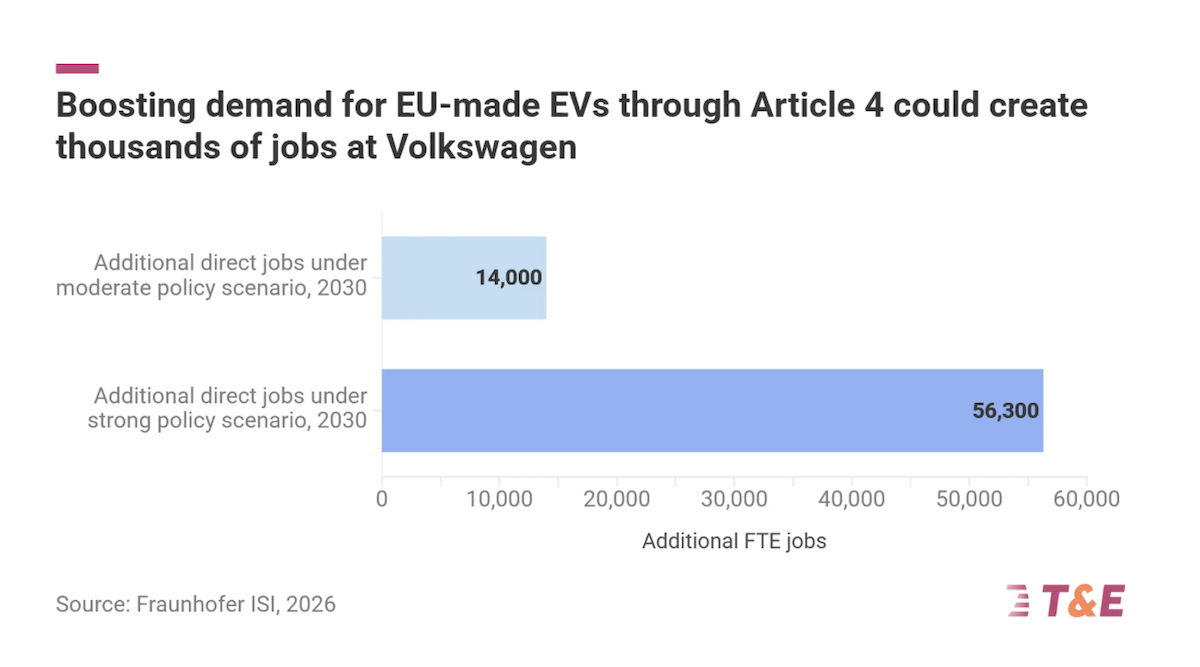
The analysis specifically evaluated effects on major automotive manufacturers. For Volkswagen, Europe’s largest carmaker, the regulation could substantially impact production plans. Under a moderate scenario, corporate battery electric vehicle sales would increase by approximately 99,000 units by 2030, offsetting roughly 14% of announced production reductions. A more aggressive implementation scenario projects an increase of around 590,000 vehicles, potentially offsetting 84% of planned cuts. These projections correspond to significant employment implications, with estimates ranging from 14,000 to 56,300 direct jobs depending on implementation intensity.
The geographic distribution of economic gains aligns with existing automotive and battery manufacturing capacity across EU member states. The analysis suggests that Article 4 implementation could meaningfully address or substantially mitigate announced corporate restructuring plans in the European automotive sector.
Article Attribution | Read More at Article Source
Article summary produced by Claude AI